
How to write mind-grabbing story hooks
Hijack the genius of the most ripped-off copywriter alive

Last week, I showed you how to curate little-known stories in your niche.
Today, I’m going to help you generate irresistible mind-grabbing hooks for those same stories by hijacking the genius of one of the most ripped-off copywriters on the internet—John Carlton.
Carlton was the secret weapon behind some of the biggest advertising winners of the late 1990s.
One of his golf ads ran for 12+ years without a single word change and pulled in millions of dollars.👇
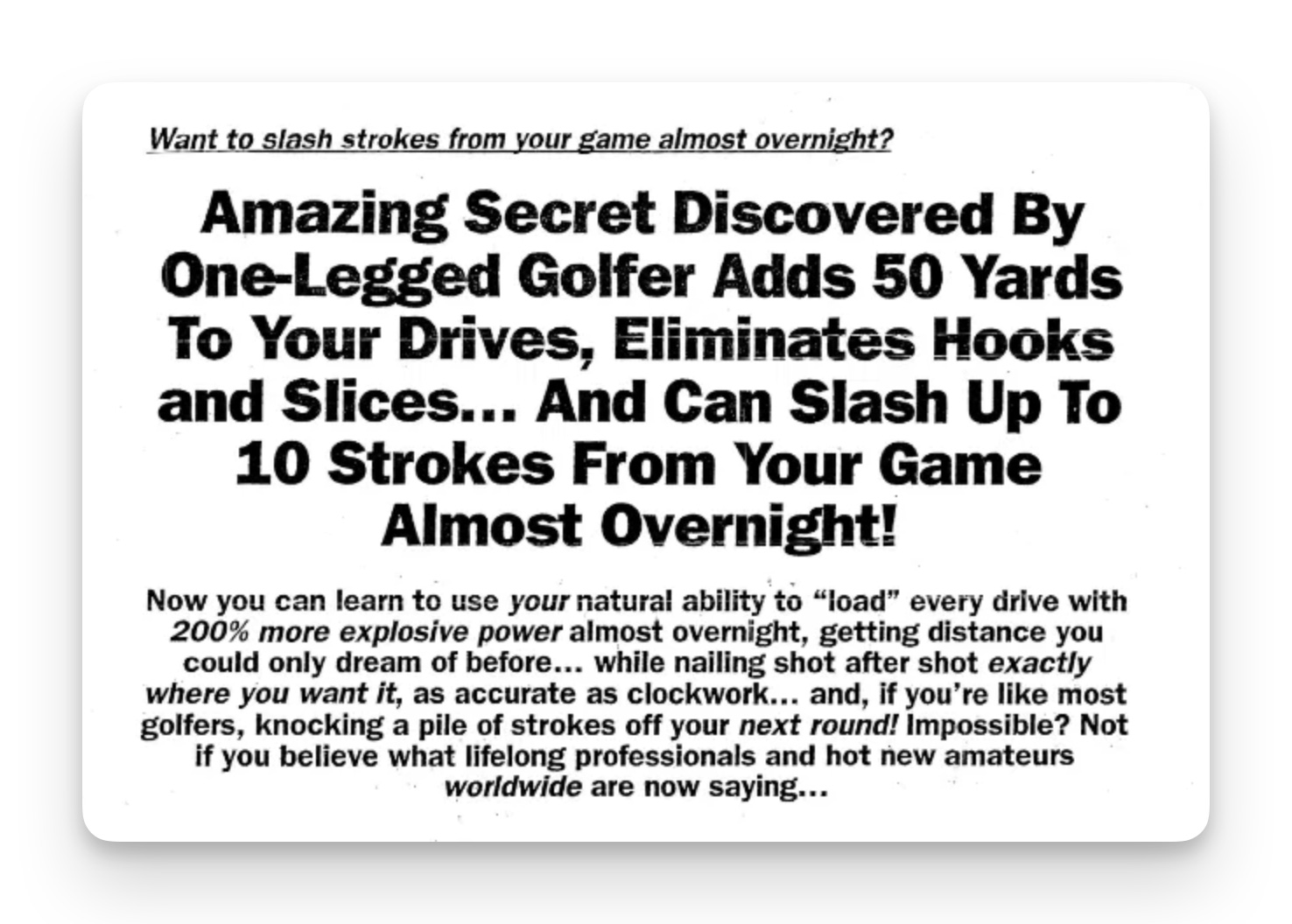
The reason his ad grabs your mind is because it’s visual—and shocking. If a golfer with one leg can crush a golf ball, then surely two legs will do even better, right?
That’s what Carlton’s hooks do. They create compulsion. Readers can’t NOT finish the ad.
And that matters because the hook is the only thing standing between your content and the trash. If you don’t grab attention, nothing else you write matters
So, how did Carlton come up with his hooks?
Here's how:
Before writing a single word of copy, Carlton researched obsessively:
Sales material
Product manuals
Anything he could find about what he was selling
His goal was to become conversant in the details of the niche he was working in so he could speak the language.
Then he’d interview the people closest to the product—creators, manufacturers, salespeople. Anyone with insider knowledge.
He wanted:
Eccentric habits or traits of the people involved
Gossip-worthy rumors or behind-the-scenes drama
Smuggled or stolen information that led to a breakthrough
Accidental discoveries by someone tinkering in their garage
He’d pay attention to anything that made him sit up and say, “Wait a minute. Back up. You did what?” or “You’ve got to be kidding me.”
That's the story behind his famous one-legged golfer ad. Milt, the product creator, mentioned it in passing. He honestly didn't think it was unusual. It was old news to him. But Carlton saw gold.
This process could take weeks. Sometimes months.
But you’ve already done that work. Last week you curated unusual stories from your niche. Now you just need to turn them into Carlton-style hooks.
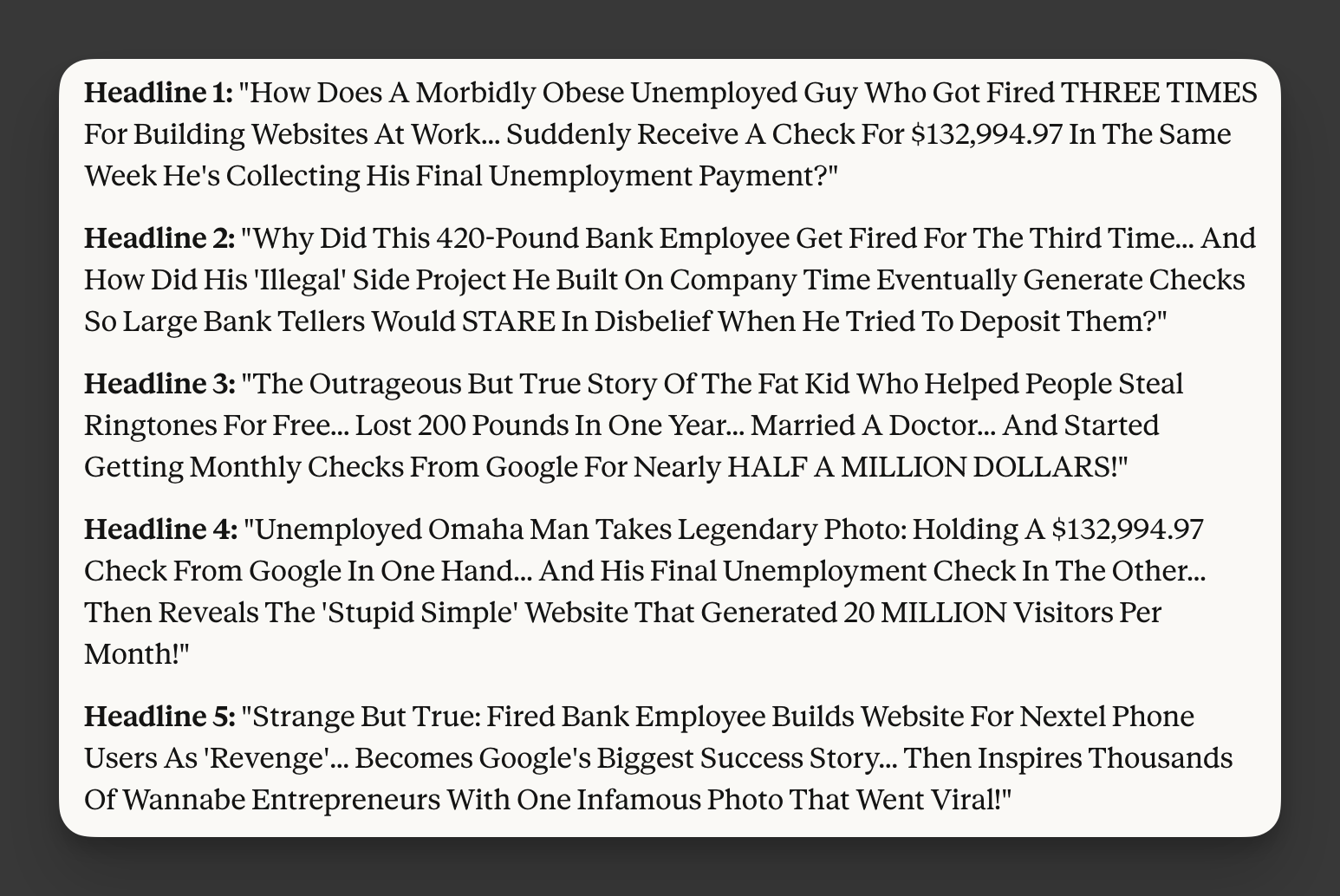
Here’s how to use Claude to write Carlton-style hooks:
You only need 2 steps.
Take the story you curated last week
Use the below prompt to generate hook variations in the style of John Carlton
Like this:
Here's an unusual story:

[Paste Your Story]

I want you to write 5 John Carlton-style headlines that create intense curiosity without revealing the answer.

Make them specific, intriguing, and impossible to ignore by leveraging shock factor, implied proof, fast results, and outcome focus in the hook

For example:

"Amazing Secret Discovered By One-Legged Golfer Adds 50 Yards To Your Drives, Eliminates Hooks And Slices... And Can Slash Up To 10 Strokes From Your Game Almost Overnight!"

"How Does An Out-Of-Shape 55 Year-Old Golfer, Crippled By Arthritis & 71 Lbs. Overweight, Still Consistently Humiliate PGA Pros In Head-To-Head Matches By Hitting Every Tee Shot Farther And Straighter Down The Fairway?"
After you run the prompt, Claude will create 5 different options.
Pick the one that makes you say, “I NEED to know what happens next.”
If you’re not dying to read it, keep iterating.
Just make sure the hook has a legitimate payoff. People are never bored by unusual stories. But they’ll feel tricked if you don’t deliver the payoff.
Create A Bridge To Your Story Payoff With Deck Copy
The hook gets your reader’s attention.
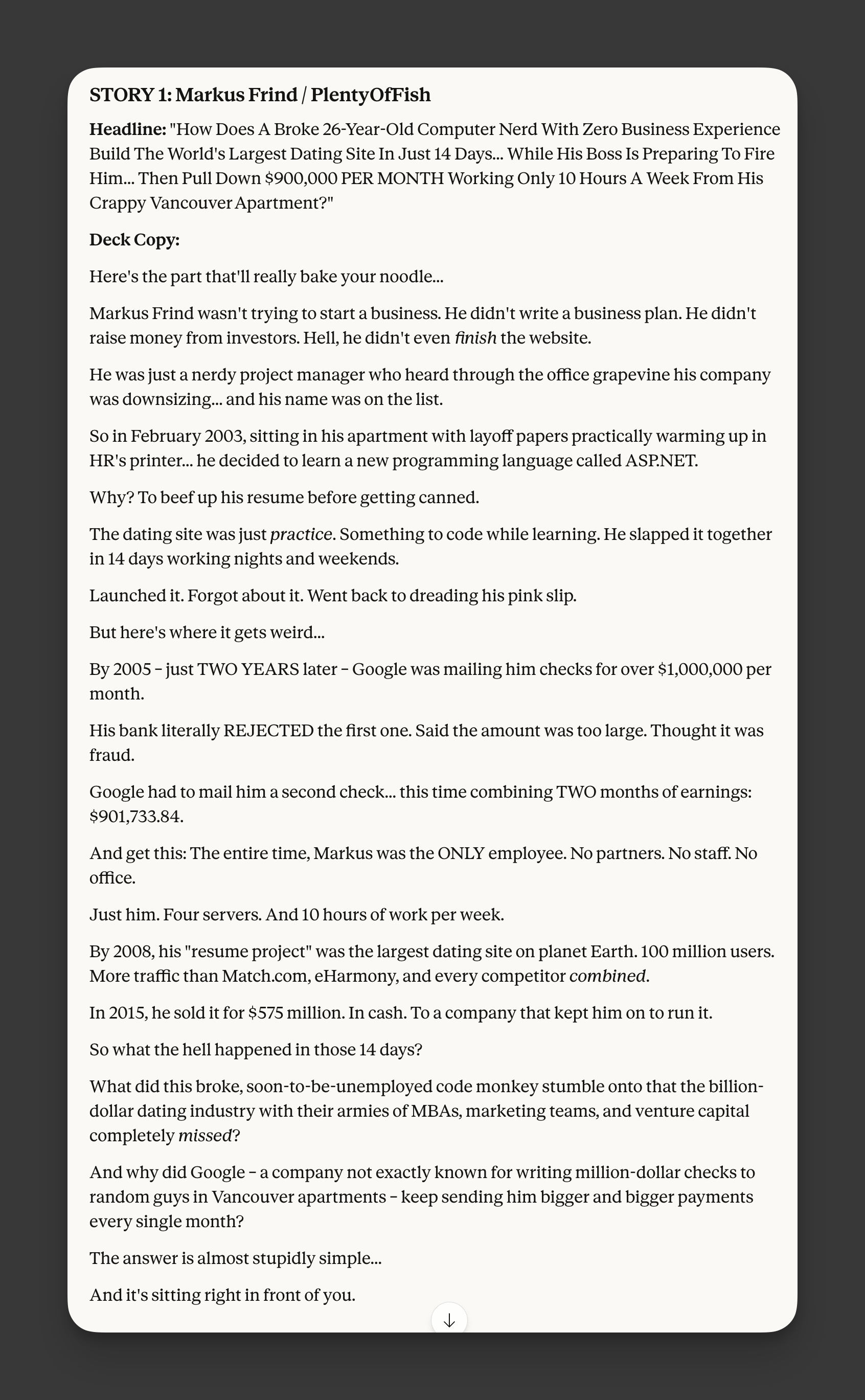
Deck copy is your bridge. It’s the 3-5 sentences between your headline and your story that keep readers moving toward the payoff.
Here’s a prompt to help you setup your story:
Great! Now write the deck copy for my story.Now you’ve got your hook and your bridge.
All that’s left is delivering the story.
John Carlton became a direct response legend because he did the research no one else wanted to do. He asked the questions no one else thought to ask. He found the stories everyone else overlooked.
And now, you can do the same thing in a fraction of the time.
To recap:
Research your topic (become conversant in the details)
Find human interest tidbits (be a sales detective)
Write story-style headlines (create curiosity without revealing the answer)
Weave the story into your copy (deliver the payoff)
AI makes it faster and easier to be a sales detective.
Now go find your one-legged golfer story.
Let me know what you think.
Chat soon,
—Dickie & Cole
Co-Founders of Ship 30 For 30
Co-Founders of Premium Ghostwriting Academy
Co-Founders of Typeshare
Co-Founders of Write With AI