
How to practice writing (and write stories with AI)

7 months ago, I started a newsletter to document the entire process of stepping into a brand new writing vertical, and growing it from $0 to $1,000,000/year.
The steps I take.
The decisions I make.
The way I solve bottlenecks.
The techniques I use to build efficiencies.
The strategies I use to market & monetize.
I’m doing it in the 1 vertical where everybody says “nobody makes a living as a writer” the most.
Fiction.
I’ve been sharing what I’m doing, and why I’m doing it, so that you can “see” the process for not just making money from fiction… but making money as a writer, period.
Because the truth is, all the same fundamental business principles apply.
And making money in non-fiction, or with selling courses, or services, or even consulting, is no different.
It’s all the same rules, just applied in different contexts.
So if you're at all interested in how I’m making money as a writer, but also how to do this in the world of fiction writing, I encourage you to check out Commercial Fiction Club.
With that in mind, today I’m resharing a post from CFC that will help you practice writing.
I’m going to walk you through an exercise I came up with. And then I’m going to show you why doing this work is so valuable and so important as it relates to AI.
Because if you don’t take the time to learn how this works manually, then no amount of AI compute power is going to help you write better.
Let’s dive in.
How To Practice
Right now, I’m reading a fascinating book called Peak: Secrets from the New Science of Expertise by Anders Ericsson.
Ericsson explains a concept I’ve intuitively understood for a long time, but never heard articulated back to me before. The big idea in this book is that practice, in and of itself—measured by time, or even repetition—is not what leads to meaningful improvement of a skill. My piano skills are a great example. I grew up playing classical piano, from the age of 3 all the way up through college, and still play leisurely today. But I am significantly worse, despite playing the same songs.
Instead, Ericsson makes the argument it is only “Deliberate Practice” that leads to new levels of proficiency. Translation: isolating specific skills and finding unique ways to practice those skills is the secret. Not just “more time” or “more reps.”
I wasn’t born a talented writer.
My vocabulary is limited. My grammatical correctness is a constant work in progress. My ability to recall legendary sonnets or excerpts from time-worn novels is below average.
My superpower is not in my talent, but my work ethic. I know how to practice. More importantly, I know how to isolate a skill I want to improve, create constraints that increase the ease of output, force repetition, and then stick with it despite the little, critical voice in my head trying to persuade me otherwise: “This is pointless. This won’t work. You’re stupid.”
I’ve learned how to love monotony and trust the process.
Since this is such a hard thing to articulate to other aspiring writers, many of whom would prefer to avoid such isolated practice and instead daydream about “how to become a better writer” in the most general sense, I thought a piece on the topic of practice would be helpful. And, taking a page out of the archive of age-old writing advice, I believe the most helpful thing I can do is not “tell” you how to practice… but show you what it looks like.
So…
A skill I want to improve is writing fiction.
But that’s actually not one skill.
“Writing Fiction” is what I like to call an umbrella term, which encompasses lots of other skills within it. So it’s not very productive to say, “I want to get better at writing fiction.” First, we must unbundle that umbrella term, and list out the collection of skills that, when combined together, amount to the umbrella skill of “being good at writing fiction.”
A few skills that come to mind are:
Story Seed: The “elevator pitch” and premise of the story.
Outlining: The beat-by-beat arc of the story.
Worldbuilding: The world in which the story is set.
Character Development: The main characters of the story.
Pacing: The story’s rate of revelation.
Narrative Voice: The tone and style of the narrator.
Word Choice: The nuances of the story’s literary style.
Etc.
Notice, it’s not until you unbundle “Writing Fiction” that you realize how difficult it would be to practice, and see meaningful improvement with all these different skills, simultaneously. It would be like trying to learn how to dance and speak a foreign language and pat your head and rub your stomach at the same time. It’s too much “new” information all at once.

So, as writers, how do we improve?
First we unbundle the umbrella term (Writing Fiction).
Next, we isolate each of the different skills.
And then we pick one skill, create an exercise, set constraints, and deploy as much volume as possible to force repetition of that skill in isolation.
In this case, since all stories are really just expanded versions of its “seed,” I want to improve the skill of writing Story Seeds.
So, let’s ignore everything else and create an exercise to just practice writing seeds very quickly:
1-Sentence Seed
As a general rule when it comes to writing, I tend to believe that if you don’t know what you’re saying in 1 sentence, you won’t know what you’re saying in 1 paragraph, or 1 page, or 1 chapter, or 1 whole book.
All writing, every form of it, is really just the expanded version of some smaller, more compact idea. And there are infinite ways to expand those idea-kernels. More description. More worldbuilding. More character development. More dialogue. Etc.
Which means one of the most valuable skills a fiction writer can build is one’s ability to write a succinct, single-sentence seed.
So, first we must isolate what it means to write a 1-sentence seed.
And then, to make it easier to build pattern recognition, we need to create some sort of formula or template to follow. This will allow us to focus more on repetition of the skill, opposed to feeling the weight of needing to “figure out what we’re doing” every time we sit down to practice.
Here’s the Story Seed Outline Template I came up with:
(C) Character Desire:
(W) Weakness:
(D) Danger:
(A) Action:
(C) Change:
And here’s the 1-Sentence Seed Template:
When <Character> experiences <Weakness>, they run into <Danger> and must <Action> to <Change>.
Next, to help us begin to build pattern recognition, we want to pull or create some familiar examples of the thing we’re trying to create.
Here’s the 1-Sentence Seed of Star Wars IV:
(C) Character Desire: Luke Skywalker, wants to be a pilot and fight with the rebellion, unknowingly a Jedi
(W) Weakness: Naive, impetuous, paralyzed, unfocused, lacking confidence
(D) Danger: The galactic empire is trying to take over
(A) Action: Uses his skills as a fighter (and budding skills as a Jedi, using the force)
(C) Change: Self-esteem, a place among the chosen few, a fighter for good
Said in a single sentence:
When a princess falls into mortal danger, a young man uses his skills as a fighter to save her and defeat the evil forces of a galactic empire.
Now Expand The 1-Sentence Seed Into A Story Seed
Lastly, once we have our 1-sentence seed, and have clarity over the 5 core parts of the story (Character Desire, Weakness, Danger, Action, Change), we can then expand on our single sentence and flush out a true Story Seed in its entirety.
After studying hundreds of stories, here’s the expanded template I came up with:
<Unsuspecting Main Character> has an unconventional skill, but is stuck in an environment where his/her full potential will never be fully realized.
This is because he/she believes <A Lie About Themselves/The Way They See The World>.
But this flawed self-belief is challenged when <Danger> happens, putting them in an impossible situation where they must choose: succumb to the lie and stay stuck (and have things get worse), or take a chance but have to face this faulty self-belief head-on.
When <Main Character> chooses to go on the journey, they run into a series of <Characters>, each of whom shows them a different way of seeing the world.
<Main Character> explores the world, builds new skills, and has their flawed self-belief(s) challenged in all kinds of ways.
<Main Character> eventually reaches a breaking point, and can’t stand “the growth” anymore. They just want to return home.
But <Danger> is looming, and they can’t. They must go further into the unknown, and confront their fears once and for all.
So they devise a <Plan> to confront the <Danger> head-on using their new skills, and new ways of seeing the world, to take <Action>.
And when they do, they are victorious—and <Change> as a result.
*Side note: You should be able to see how you actually don’t need to write 300 pages to figure out what your story is about. All you need to do is “tell” the entire story in a succinct sentence, and then expand that sentence into 5-10 other sentences, and suddenly you can “imagine” the entire story arc. This is the goal.
So great, now we have:
Isolated the skill
Created a 1-sentence template
Referenced an example
Created an expanded template
Which means the only thing left to do is to practice!
And when I say practice, I do not mean 15 minutes on Sunday, one time, with the expectation you will suddenly, instantaneously, magically become the world’s most proficient story seed writer.
I mean isolated practice, consistently, over a prolonged period of time.
So now, to improve at this skill, I need to write a bunch of seeds!
To “show” you what this looks like, here are a handful of seeds I’ve written for myself—with the sole goal of improving at this one, isolated skill, not worrying about anything else.
💰Story Seed 1: My Number Is More
Seed Template:
(C) Character Desire: Freddy, an ousted founder with a couple million in his golden parachute payout, “retires” wants to live the simple life in LA as an angel investor
(W) Weakness: Can’t shake comparisons, jealous of others who “won” the startup game and achieved more than him. Still has something to prove
(D) Danger: Invests in a company nobody else believes in, and it takes off. When they exit, he’ll be rich. And he vows to protect the young founder/CEO in the process.
(A) Action: But when the young founder begins making poor/risky decisions, and puts Freddy’s exit at risk, he’s forced to make a hard decision.
(C) Change: Freddy leads the charge to oust the founder and take over the company, exit, and achieve his goal of entering the true “elite”—but is morally conflicted in the end.
1-Sentence Seed
Freddy, a 32-year-old millionaire tech founder has just been ousted from his company (his baby) and forced into retirement as a semi-wealthy investor, when one day he meets an up-and-coming founder who could use his help.
Expanded Seed:
Freddy, a 32-year-old consumer tech founder, should be happy. He’s just exited his first company and gotten a generous golden parachute package from the board, bought a nice house in Hollywood Hills, and has enough runway where he doesn’t need to work again for at least a decade. He’s achieved what most people dream of—and yet, for Freddy, despite his best efforts to be proud of himself, he can’t help but feel bitter and unsatisfied. Because he didn’t exit his company on his own accord. He was ousted by the board. And while, on paper, he’s “rich,” he’s far from rich compared to his peers. Deep down, Freddy doesn’t even know how much money he wants or needs to be truly happy. But anytime any of his founder friends has asked, “What’s your number?” his response has always been, “More.”
Bored of early retirement and casually angel investing in startups, most of which are local to LA/Silicon Beach, Freddy gets exited one day when he takes an unconventional meeting at Soho House West Hollywood. A young, twenty-something, disheveled, off-beat founder named Josh Jerickson (JJ) surprises him with a consumer tech platform Freddy immediately recognizes will be a hit. JJ is new to LA and isn’t hip to the game yet, and Freddy (a seasoned vet with entrepreneurship PTSD) feels both compassionate and protective of JJ, while simultaneously aware of his desire to exploit JJ’s weaknesses. He promises JJ the world, that he can help take him and his platform all the way, and joins the company as an active investor.
And it works! We see JJ and Freddy go on to do great things together—they’re the perfect match, mentor & mentee. That is, until Freddy introduces JJ to the secret, elite world of Los Angeles—the intersection of entertainment and big tech—and JJ doesn’t know how to handle this new life of fame, fortune, and debauchery rationalized as “networking.” In fact, JJ becomes addicted to the lifestyle, so much so that right as his company is being courted by a multibillion-dollar tech company for an acquisition, JJ can’t be found. He’s gone off the deep end, putting everything they’ve worked so hard for at risk.
In the end, Freddy—who has helped the company raise tens of millions of dollars, hire hundreds of people, and fill their board of directors with highly influential people—is put in an impossible position. Does he try to save JJ, and protect him from being ousted, experiencing the same fate Freddy faced as a first-time founder? Or does he capitalize on JJ’s weaknesses, and get his retribution—take over the company, successfully exit, and become one of the wealthiest players in this highly competitive game of entrepreneurship and investing?
✍️ Story Seed 2: The Pulitzer Plot
Seed Template:
(C) Character Desire: Reese, a graduate of the acclaimed Iowa Writer’s Workshop MFA program, has only 1 goal in life—to win the Pulitzer Prize in fiction.
(W) Weakness: But Reese is a notorious perfectionist, and as soon as he leaves school (his accountability/support system), the years start passing him by. He overthinks his work to the point where, eventually, he stops writing altogether.
(D) Danger: Now working as a barista, late-twenties, one day an old classmate (Kylie) walks in. They chat it up, and Kylie lets Reese know her first novel has not only been published by a major publisher, but has won a handful of literary awards and is now being nominated for a Pulitzer. Reese can’t believe it, and hates her for it.
(A) Action: Reese must swallow his pride and go back to where it all started. He seeks out an old professor from college and asks him to be his mentor.
(C) Change: Reese writes a magnificent novel that gets published, but in the end is not even considered for the Pulitzer Prize. But that’s OK with him, because he’s learned the real reward was falling in love with writing again.
1-Sentence Seed
When Reese graduates from Iowa’s Writer’s Workshop with the goal of winning the Pulitzer Prize in fiction for his first novel, he finds himself in a self-destructive loop of perfectionism, eventually leading him back to his fiction professor (Bridges) to learn how to get out of his own way as a writer.
Expanded Seed
Reese only has 1 goal in life: to win the Pulitzer Prize in fiction.
But after graduating from the acclaimed Iowa Writer’s Workshop MFA program, with no more writers circles or his favorite professor (Michael Bridges) to nudge him along, Reese puts all sorts of expectations on himself for his first novel to be this magnum opus—critically acclaimed, loved by everyone. So much so, that Reese falls into the horrible habit of perfectionism, to the point where he begins talking himself out of anything he wants to write long before he gives himself the chance to write it.
To pay his bills, Reese finds himself stuck in a dead-end job as a barista. He’d originally taken the job because of the hours, and because that’s what most aspiring writers do. Something that doesn’t require much mental bandwidth during the day, to preserve more mental energy to write at night. But now, Reese doesn’t write at night, just scrolls and scrolls and insists he’s still a better writer than all the other writers out there experiencing success. But he’s delusional, lying to himself, rationalizing his lack of action.
Everything changes when, one day, an old classmate (Kylie) walks into his coffee shop. They chat it up, and she reveals her first novel has received significant attention. It was published by a major publisher. It won a handful of literary awards. And now, it’s been nominated for a Pulitzer. Reese is fuming with jealousy, and spends the rest of the week cycling through every emotion: anger, sadness, frustration, hopelessness, etc.
Eventually, he reaches a breaking point and goes back to Iowa to visit his old professor, Bridges. Bridges is honest with Reese, letting him know that while he is talented, he’s always been his own worst enemy. And he will need to commit to improving more than just his writing, but himself, if he wants to have any hope of achieving his literary goals—and maybe one day, winning a Pulitzer himself.
We watch Reese stay in Iowa and, in funny & heart-warming ways, get mentored by the compassionate Bridges. And by the time Reese finishes and publishes his first novel, whether he wins a Pulitzer or not is irrelevant. The real reward is that he became the kind of person capable of writing something so terrific and elegant at all.
👑 Story Seed 3: The King
Seed Template:
(C) Character Desire: Cyrus, third-generation and heir to the kingdom of Vox, wants to prove he deserves the life of power and influence he was born into, and is being handed on a silver platter.
(W) Weakness: So much so, that Cyrus is temperamental, irrational, and clouded with poor judgement rooted in short-term thinking.
(D) Danger: But his father dying, and the responsibilities of the kingdom, are far from his biggest problem. A great danger threatens their kingdom, and Cyrus’s esteemed position within it.
(A) Action: When the surrounding territories, and eventually the kingdom of Vox goes to war with the returning threat of the once-defeated Hellfire clan, back for revenge and retribution, Cyrus must decide what kind of king he needs to become—a king for his people, or a king who only looks out for his own self interest.
(C) Change: Cyrus, in the end, must choose between being seen as a hero but losing the war, or being seen as a failure but taking the enemy down with him.
1-Sentence Seed
When Cyrus, the heir to the kingdom of Vox, is confronted by an old enemy (the Hellfire clan) and threatened with war, Cyrus must decide whether he is willing to die for his people.
Expanded Seed:
Cyrus, third-generation and heir to the kingdom of Vox, wants to prove he is deserving of the throne—which is no easy feat when everything is taken care of for him. Cooks. Maids. Watchmen. Spykeepers. Scribes. Mistresses. There is no luxury or indulgence Cyrus does not have access to, and no annoyance or difficulty he cannot solve with a flick of the wrist or a glance of the eye.
But his luxurious life, in which he gets all of the benefits and none of the responsibilities, gets turned upside down when his father, Darius (the current king) passes suddenly. Cyrus finds himself burdened with decisions for all of their kingdom’s people—who deserves what rations, whether to subsidize the farmers, who to train for battle, and so on. And unprepared for this level of responsibility, Cyrus resorts to even more escapism. Long nights in dark alleys. Relationships that don’t have his best interests in mind.
Until one day, a skydweller from the outskirts sends back news: the Hellfire clan is back, and they have multiplied in size. They begin by attaching small towns. But then inch their way, territory by territory, further inland, until it becomes clear they are headed to the very center of the Vox kingdom.
Now, threatened with battle, Cyrus must snap himself out of his wormhole of indulgence and carry the weight of his title as king—that is, if he wants to have any chance of surviving, and having a kingdom to rule at all.
Improvement From Here
The above is what isolated, deliberate practice “LOOKS LIKE.”
Unbundle the umbrella skill
Isolate a more specific sub-skill
Create an exercise and set constraints
Deploy as much volume as possible to force repetition
This is what’s required for true progress and development of skill.
But… where do you go from here?
First of all, most people never do the above. Even if they know they should, they just don’t. They either don’t think it’ll work (or that it’ll work for them). Or they’re so afraid of “wasting their time” focusing on the wrong thing that they just fall back into what’s comfortable (which, ironically, ends up being the longer road in disguise). So if you can successfully isolate specific skills and repeatedly practice them, congratulations—this is what the Top 1% do, in any domain of expertise.
Second, let’s say you ARE doing the above.
2 Options:
Education: You need to educate yourself on “better.” Whatever skill you want to improve at, how do you do it “better?” Well, if you knew, you’d probably already be doing it! Which means you have more to learn (we always do). You can solve for this in any number of ways. You can read and study more about this specific skill. You can pay to learn from someone. You can attend workshops or masterminds. You can join communities. The point is, you need to invest in your education.
Accountability: The other way to improve is more through accountability and specific feedback. It’s less about finding some new, unique way of doing things “better,” and more about having someone raise your standard of excellence. This is where finding a coach, accountability buddy, or mentor of some sort is tremendously helpful.
The ultimate goal, of course, is not to reach 100% proficiency in one individual skill and then and only then move on to the next.
The goal should be to reach ~80% proficiency (which doesn’t take a lifetime, it takes like 50-100 hours max) and then move on to the next. Most writers (myself included) overestimate how long it takes, and how much effort it takes, to improve at an individual skill. But more often than not, while the number ends up being more than you want, it’s usually less than you think.
How To Do This With AI!
Knowing how to learn, and how to acquire new skills, quickly, is a superpower.
But in the age of AI, and “autonomous technology,” we can now get way more leverage out of our Manual Work.
What so many writers don’t understand (about Manual Work, but also how it connects to Automated Work) is that anytime you “deliberately practice” anything, you aren’t just practicing. Here’s what you’re really doing:
Your manual exercise = your AI prompt
“Doing” your manual exercise = your AI training data
For example:
What did I just do?
I created a specific exercise for myself.
I crystallized this exercise by writing a newsletter about it (forcing function for my own learning, which is leverage… and, a newsletter is a digital asset, which is more leverage… and, this is a paid newsletter, aka a product, which is more leverage).
I then “did” the exercise myself—following the instructions of my own exercise.
Which means all my “reps” are training examples (for AI) to reference when following the rules of the same exercise (even more leverage).
This is what makes writing such an insanely powerful skill in the 21st century.
You aren’t just writing “for yourself,” and you aren’t “just practicing.” You’re getting leverage out of the writing when you share it online with other people. AND, you get more leverage out of the writing when you realize “your writing” is actually the prompt & training data you need to give AI to help you do “that type of writing,” 10x faster, forever.
Crazy.
Writing Story Seeds With AI
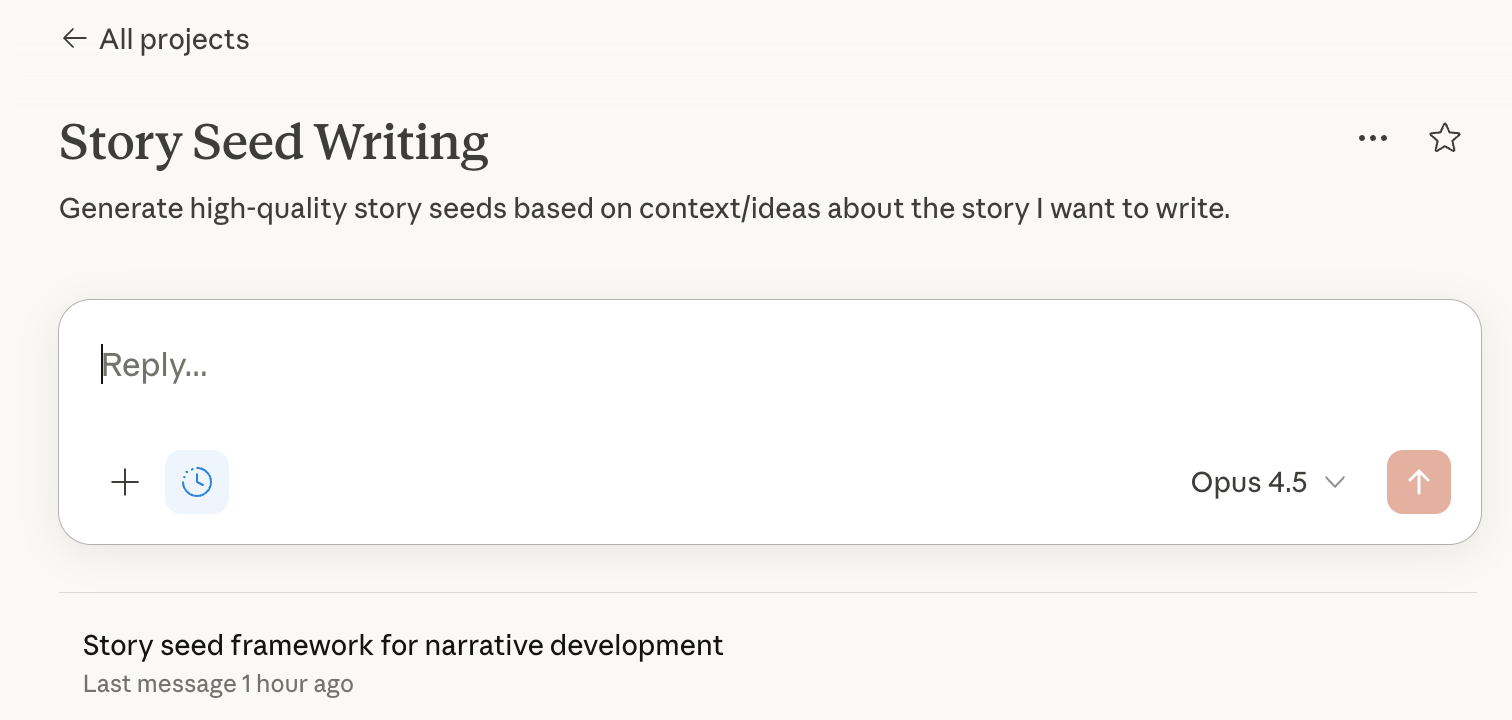
Now, I can ask for AI’s help—because I know a) how to articulate “how to do” the thing I’m trying to do, and b) I did “the thing” a bunch of times myself, creating examples and pattern recognition for AI.
Which means, not only have my skills improved (at writing Story Seeds) improved VERY quickly… but I also have the necessary components to get AI’s help executing this skill, at a highly proficient level, forever.
Now that’s leverage.
And as a subscriber to Write With AI, I want you to have the final output.
Click the link below for the prompt in Notion (it’s long, and that’s the point):
