
7 lessons from 2,500+ days of journaling
Plus my favorite AI prompts for when you're stuck


Over the last 7 years, I’ve journaled basically every single day.
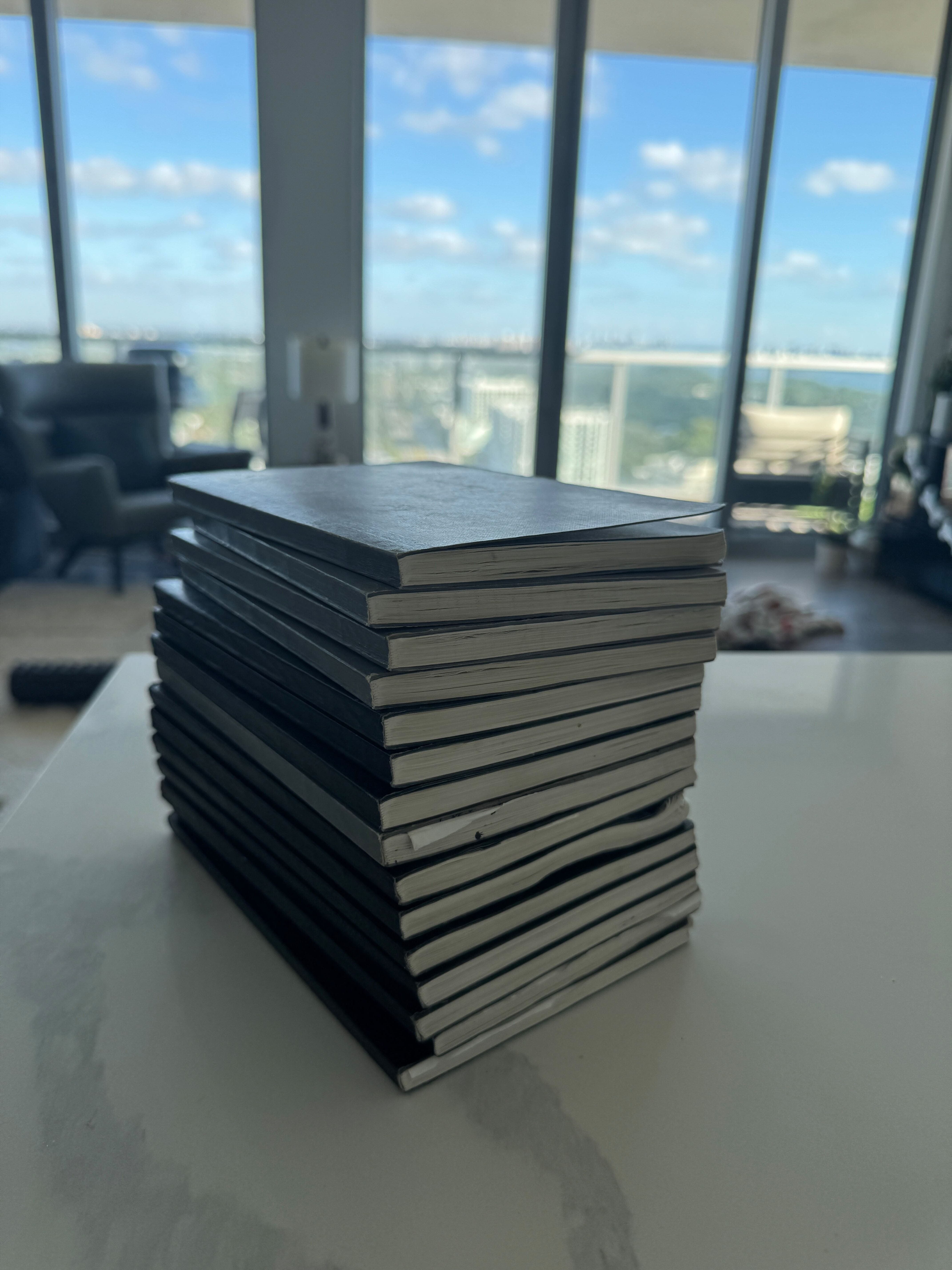
And during that time, I’ve filled 30+ handwritten journals, thousands of pages of text journals, and learned more about myself than I ever thought possible.
Looking back, these are the 7 biggest lessons I’ve learned from journaling my thoughts every day:
🤖 I’ve included links to a few of my favorite AI prompts to help you apply these lessons and give you a place to start when you’re not sure what to write.
Lesson #1: I’m always 90 minutes of journaling away from clarity
Of all the benefits my journaling practice has given me, the biggest one is clarity.
I’ve experienced quite a few life-changing events in my 20s:
I helped my mom fight through Stage IV ovarian cancer
I started my dream job at BlackRock (and then eventually quit)
I spent 3 months living alone in New York City during COVID
I unexpectedly lost my dad when I was 27
I built a business to over $20m in total revenue
I visited over 15 different countries across multiple continents
Each of these has at certain points contributed to a feeling of overwhelm.
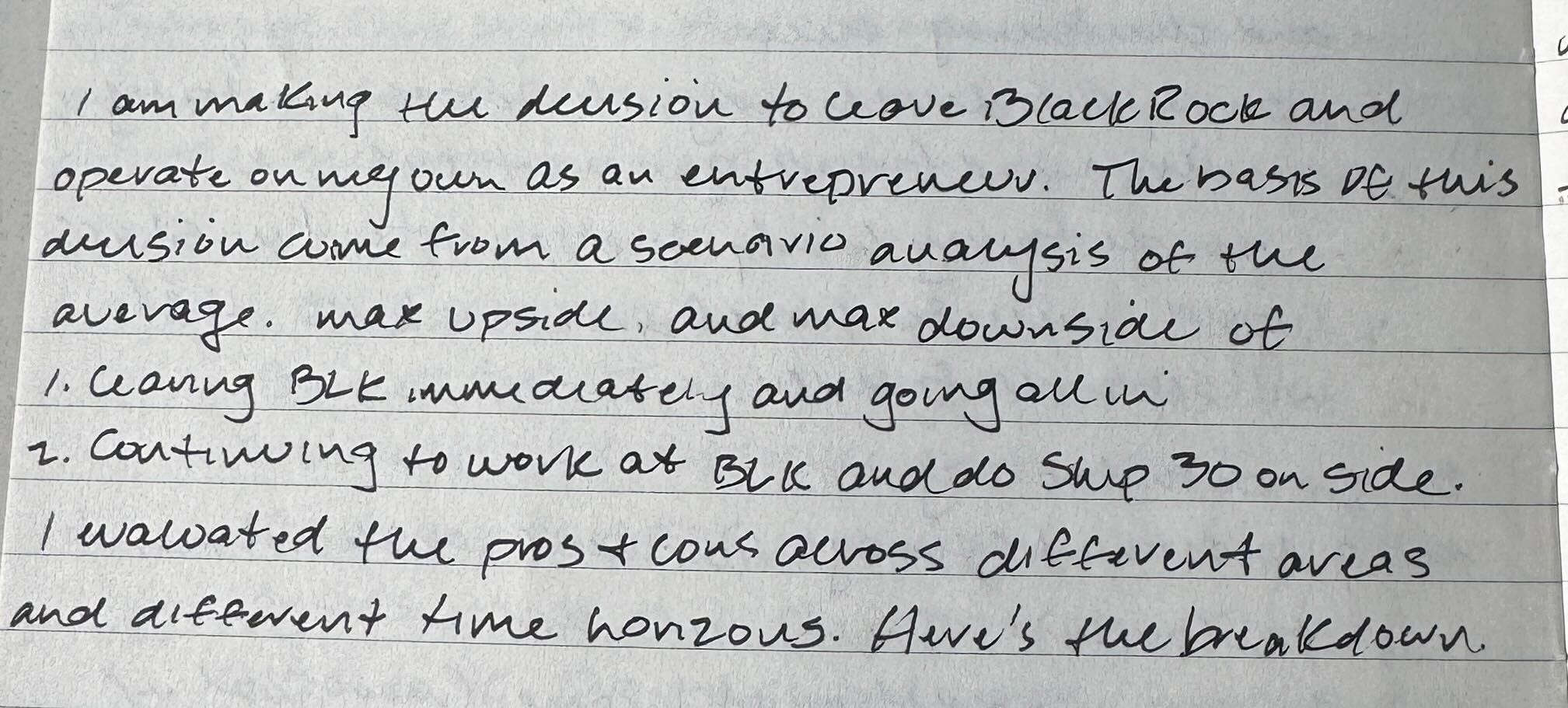
“I am making the decision to leave BlackRock and operate on my own as an entrepreneur. The basis of this decision came from a scenario analysis of the average, max upside, and max downside of:
Leaving BLK immediately and going all in
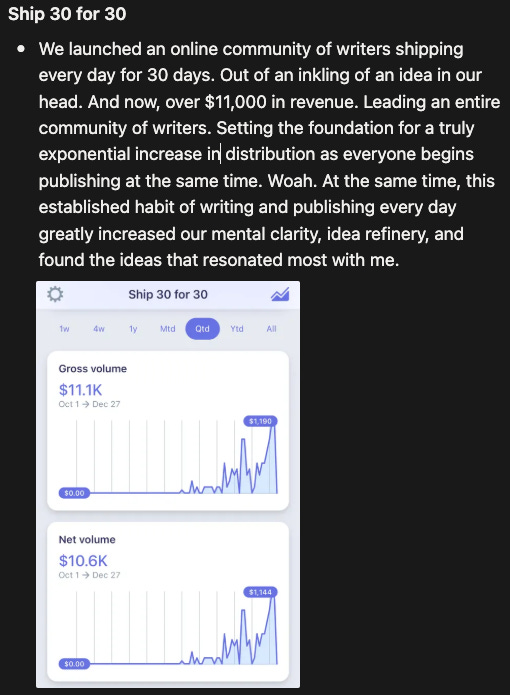
Continuing to work at BLK and do Ship 30 on side.
I evaluated the pros + cons across different areas and different time horizons. Here’s the breakdown.”
Whether it was taking on too many things in the business, dealing with emotions I had never experienced, or unlocking new paths that each deserved careful consideration.
And there were periods where I just could not turn my brain off as it tried to process everything that was going on.
However, over time I’ve built pattern recognition for what I need to do when I start to feel this way, and it’s pretty simple.
I need roughly 90 minutes of focused time
I need to be removed from my normal environment
I need to be unreachable from the outside + be unable to use the internet
I need my pen & paper journal + an espresso
I need to clear my mind by getting every single thing out of my head and onto the page
And every time, like clockwork, I emerge from these sessions with a sense of control & organization.
So much so that I think I’ve been able to go extended periods without taking many days off, as long as I get this reflective time to myself.
The opposite of this is true as well.
When I look back at periods where I did experience extended overwhelm, it’s when I got away from this journaling habit.
Whether in a new environment
Or constantly on the go
Or for whatever reason I broke the habit
Extended periods without journaling lay the foundation for overwhelm.
Lesson #2: Most things you’re caught up in will not matter
Here’s an experiment I want to run:
Take my last 7 years of journals, combining all physical & paper versions
Digitize them into one long, chronological file from start to finish
Then ask it to rank the 7 individual events that caused me the most stress or worry
Then I want to come up with my own list, and see if they match up
I have a hunch that the things I was most caught up in actually did not end up mattering at all. All of the energy I spent on them was likely wasted. I either thought they mattered way more than they did, or I spent time trying to control an outcome that was ultimately unpredictable.
And that’s the beautiful part of having such a rich set of journals.
If I pick up a journal from say, 2022, and look at a random day, chances are that I was caught up in something.
Either something someone said to me, or worry about a particular employee, or my sleep score being suboptimal for too many days in a row, whatever it may be. And when I look at entries like that, I can’t help but laugh because at the time, it felt like the most important thing in the world.
But a few years later, it clearly wasn’t.
Now, the real benefit of this is that I can pull this same idea into the present moment.
If I jump forward to future me and look back on current me, chances are they are laughing at all the small things that I’m currently caught up in.
This insight has dramatically lowered my stress levels in the present moment and allowed me to not taking things so seriously. Sure, I’m still intentional with my decisions & pay attention to my emotions, but I don’t let them control me too much.
Because I know how little they matter in the long run.
Lesson #3: Journal like you’re outlining your future memoir
This is how I think about journaling.
Every day when I sit down to brain dump my thoughts, I think about how grateful I’ll be when I’m 80 years old getting to look back on 29-year-old me. And I know this is true because I would do anything to have the same thing for say, 11 year-old me.
What did he have going on?
What was he thinking about?
What was consuming his attention?
Now obviously, I can’t go back and journal in the past.
But this line of thinking creates a dual benefit to my journal practice.
I get the immediate benefit of clarity in the present moment.
And I get the added benefit of “pre-writing” the future memoir I’ll write as I get toward the end of my life. Through that lens, I make sure to constantly list small moments that I know will create vivid memories for future me.
I mean just think for a second:
You’re 80 years old
You have a beautiful book shelf in your long-time home
You have entire SHELVES of journals, stacked horizontally in chronological order
You have them all digitized and documented so they’re searchable
You get to show your children what you were thinking about at different points in your life
You get to highlight specific moments with vivid details that you can only remember when rereading them
And you can pass them down for generations in the future
The thought of that excites me more than any other thing I’m working on at the moment.
Lesson #4: There is no perfect journal routine—and your journal routine will evolve
If you asked me “what’s your current journal process” at any point over the last 7 years, you would probably get a different answer each time.
I’ve had periods where I journaled within 5 minutes of waking up
I’ve had periods where I typed dozens of pages every morning
I’ve had periods where I only journaled to end the day
I’ve had periods where I only wrote 3 sentences because I was busy
I’ve had periods where I used voice notes to talk about my day
And so if you took each of these as advice, you’d be constantly changing your routine searching for the perfect one.
In reality, there is no such thing as the perfect routine.
And over the years, I’ve stopped giving too much prescriptive advice when people ask me how to get started journaling.
Instead, I mention a few principles:
Your journal routine should be something you can do daily
You should eliminate as much friction as possible, however that looks for you
Your journal routine should evolve with each season of life
You should write as much or as little as you need, again depending on the season
Everything else is personal preference.
So I encourage you to try and iterate based on what you ENJOY.
A simple test of this is how much pre-excitement the idea of getting to sit down and journal brings to you.
As I’m writing this post today, I started the morning with a quick brain dump of how beautiful my life looks at the moment over an espresso and cigar. And that scene, just thinking about it the night before, brought a huge smile to my face.
And to me, that is the perfect journal routine.
Lesson #5: Reading journals from 3 years ago creates a lovely feeling of gratitude & a fulfilling feeling of growth
Growth is having problems today you would have begged to have had years ago
If I was going to prescribe someone a set of activities to make them miserable, I would have them do the following:
Constantly think about all the things you want but don’t currently have
Compare yourself to other people who are doing better than you
So following the simple principle of inversion, I know I can avoid a lot of feelings of disappointment if I just avoid those two things.
And it just so happens that journaling lets me do that.
Rather than spend time thinking about all the things I don’t have, I can look at all the things I do have compared to the younger version of me.
I can make a massive list of all the things that version of me would have begged to have had then that I’m fortunate enough to have now.
And that simple exercise fills me with gratitude.
At the same time, rather than comparing myself to people more successful or further ahead than me, I can bask in the feeling of growth by comparing myself to the younger version of me.
If I pick up my journal from 2021 and read it, it’s immediately apparent how much I’ve grown.
I’m more wise
I’m more calm
I’m more skilled
I’m more mature
I’m more ambitious
I’m more thoughtful
The list goes on and on.
And that type of positive comparison would be impossible if I didn’t have the ledger my journal creates.
Lesson #6: Everything works out in your favor on a long enough time horizon
Throughout my history of journaling, I’ve had a handful of devastating moments.
Moments where it felt like the world was ending
Moments where I didn’t know how I’d keep going
Moments where I doubted everything I’d ever done leading up to it and where I would go from there
And because I have each of these documented, and thought-through, and distilled in my journals, I can relive how I felt at the time with very little memory distortion.
And guess what?
I survived.
Life did indeed keep going on.
And at this point, I can look back on each of those moments as something I’m incredible grateful to have experienced.
Each of them has shaped me into the person I am today. Each of them has altered my trajectory to take me to this exact moment, writing for 6 hours on a Saturday morning.
And now I can take this same lesson and bring it into the present moment.
If something happens to me that seems impossible to overcome or to recover from, I can rely on this framework.
I can jump forward to future me, where ever they are, and know they are looking back on that event with gratitude.
Lesson #7: Journaling is a filter for negative compulsive or emotional action
I am not a very fast thinker.
I tend to process events methodically. I like to be intentional in my decision-making. And I seek to avoid responding to events from a place of heightened emotion.
And journaling is what allows me to do that.
When I experience something uncomfortable, or need to make a big choice, or need find myself repeating a negative cycle too many times in a row, I turn to my Muji notebook to process it. And the people in my life know when I’m overdue for a session like this, because I tend to retreat emotionally.
They can tell I’m not fully there, because I’m not. Behind the scenes my brain is stuck trying to process something
To recap… here are the lessons from my journal process:
Lesson #1: I’m always 90 minutes of journaling away from clarity
Lesson #2: Most things you’re caught up in will not matter
Lesson #3: Journal like you’re outlining your future memoir
Lesson #4: There is no perfect journal routine—and your journal routine will evolve
Lesson #5: Reading journals from 3 years ago creates a lovely feeling of gratitude & a fulfilling feeling of growth
Lesson #6: Everything works out in your favor on a long enough time horizon
Lesson #7: Journaling is a filter for negative compulsive or emotional action
That’s it.
Chat soon,
—Dickie & Cole
Co-Founders of Ship 30 For 30
Co-Founders of Premium Ghostwriting Academy
Co-Founders of Typeshare
Co-Founders of Write With AI
PS…Decision Journaling is how I decided to quit Wall Street & become a full-time entrepreneur.
I also use it to make quick decisions so I can make rapid progress in my business, career, and relationships.
And next week, I’m revealing my entire system.
Join the waitlist here:
https://decisionjournaling.com/

I vibe with, a filter for negative compulsive or emotional action.
"The people in my life know when I’m overdue for a session like this, because I tend to retreat emotionally. They can tell I’m not fully there, because I’m not. Behind the scenes my brain is stuck trying to process something."
This is why I NEED Decision Journaling!
I have a stack of journals from July 2020-now!!