
[FULL GUIDE] Digital Monetization Methods: 8 Ways To Make Money Selling Your Expertise
Everything you need to build a business around something you know well


Welcome back to AI Operator: the weekly newsletter for integrating AI into every vertical of your internet business. Last month we added 659 subscribers, taking us to 2,757 total AI Operators. If someone forwarded this to you, subscribe here.
One quick heads up: today’s deep dive took me a month to write. It’s 13,000 words long. I recommend reading it in the browser, otherwise it will get cut off in your email inbox. And if you find this free post valuable, I’d appreciate it if you forwarded to a friend or shared it on social media, so more people can find it.
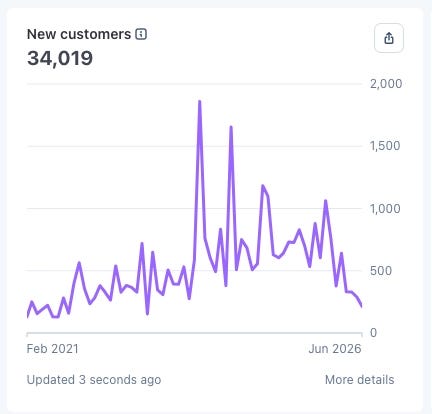
Over the last 6 years, my business has served over 34,000 customers across 8 different digital monetization methods:
Software
Digital products
Agency services
Paid newsletters
Paid communities
1:1 coaching/consulting
Cohort-based experiences
Hybrid 1:1 + group coaching
And after 6 years of operating each of these, the most common question I get is still some version of:
“Dickie, which one of these should I do?”
And I understand why. From the outside, the world of digital business looks complex. And many of the people in it are, convinced their method is best and incentivized to convince you of the same.
One person swears high-ticket coaching is the only way.
Another says agencies are dead and software is the future.
A third is making $50,000/month with a paid community and no team.
And because of this overload of information, most people respond in one of two ways:
They do nothing. They consume endless content about all of the methods while starting none of them. And this is nothing more than procrastination disguised as productivity, because they don’t have a vehicle to apply what they’re learning.
They hop from method to method. Three months on a course idea, another three months offering a service, another three months vibe-coding slop, restarting from zero each time before they can see the benefits of compounding.
Both of these responses are incorrect.
The best path forward is to first understand all of the options available to you at any given time. Then, based on your goals, experience, and preferences, choose the one that you can stick with for at least 12 months.
And that is the point of this comprehensive guide.
First, we will walk through 8 principles of digital monetization that will help you no matter which business you choose
Second, we will do a deep dive into all 8 methods to give you a full understanding of every element that goes with operating that method
Third, we will answer some frequently-asked-questions I’ve gathered through years of talking about these methods
And lastly, I’ve created a full interview prompt that will analyze your situation to help you decide which of these methods is best for YOU.
To get that prompt, all you have to do is like this post & comment “METHODS” and I’ll DM it straight to you.
Now let’s get into it.
8 Digital Monetization Principles
Before we dive into each of the methods, let’s start with some principles that will help you no matter which you choose.
All 8 “Work” — There Is No “Best” Method
You’re Choosing A Bag of Problems, Not A Business or an Income Level
The Faster It Starts, The Sooner It Caps (With 1 Person)
The More Of “You” In It, The More You Can Charge
All Methods Start With Near 100% Margin — But Only A Few Keep It At Scale
All 8 Run On The Same 3 Core Systems
All 8 Can Run On The Same Simple Marketing System
The Skills Transfer And The Methods Stack — But You Can Only Build One Piece At A Time
1. All 8 “Work” — There Is No “Best” Method
This is the first faulty belief to kill.
None of these methods are dead.
None of these methods are perfect.
And none of these methods are any “easier” than the others.
They all require significant amounts of effort, education, leverage, trial & error, and discipline. Some require different skillsets than the others, and I’ll explain those differences to you today.
Every method we will talk through can generate $10,000 or more per month in take-home income. In fact, every single one of them can generate more than $100,000 per month. Some will get to each of these milestones faster than others, and some will require different skillsets to reach either of them. But they all can get there, and we have taken nearly all of them there, with the exception of direct consulting and software (for now!).
Anyone telling you the opposite is simply selling you on the method they are incentivized to sell you on.
I am not here to incentivize you on any one method.
I am here to walk you through all of them from a place of having operated every single one of these over the last 6 years, so you can make an informed decision on which one is the best FOR YOU.
2. You’re Choosing A Bag of Problems, Not A Business or an Income Level
Since all of these methods can work, the question is not “which can make the most money?”
The better question is: “which problems do I want to spend my time dealing with?”
Every business has parts that suck.
For example, when you’re making $30,000 per month:
Running an agency you’re dealing with 6 different bosses sending you revisions, checking Slack while on vacation, and battling with setting boundaries when clients ask for things out of scope.
Running a coaching program you’re dealing with sales calls, no-shows, filling your sales call calendar, all while trying to provide the best experience for your students & manage their emotional state when they’re struggling.
Running a digital product business you’re dealing with repeating yourself, login errors, continuous content creation, launch roller coasters, and constantly looking for the next customer.
Running a community you’re battling churn, moderation drama, packing the event calendar to keep members happy, and sorting through the opinions of all your members to find the things worth implementing.
Running a paid newsletter you’re dealing with the pressure of creating world-class content, the never-ending nature of a fixed publishing cadence, and the emotional toll of many people saying your work isn’t worth more than a couple of coffees per month.
Running a software business you’re dealing with users complaining about bugs, failed payments, an overwhelming number of feature requests, and people churning without telling you why.
Running a consulting business you’re dealing with a nearly-full calendar of calls, lumpy months where demand disappears, and income that dries up the second you want to take a vacation.
Now, I could sit here and tell you all the incredible benefits of each of these methods. Because for every part that sucks, there is a part that someone operating a different vehicle would love to have.
Or, I could be honest with you that most of the way you “feel” about a business has nothing to do with the good parts, and everything to do with the bad parts.
So rather than choose the business based on those good parts, it’s better to identify the worst & most difficult parts, then actively choose those to be the problems you spend time solving.
And when we get to the method section, I’ll walk you through my exact experience operating each of these.
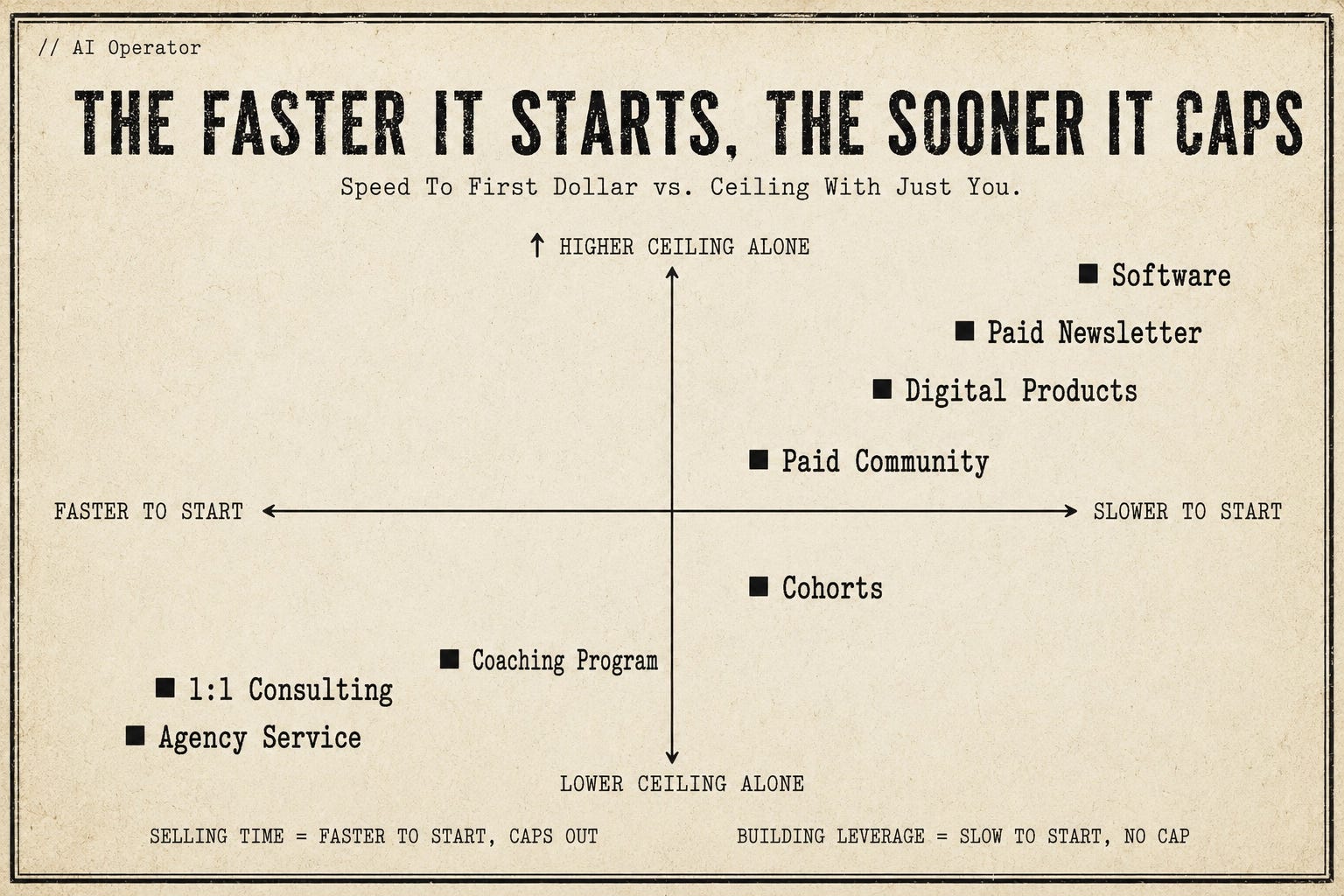
3. The Faster It Starts, The Sooner It Caps (With 1 Person)
This one requires an entire post on its own, but I’ll try to distill the concept down for you here.
Each of these types of business require a different kind of leverage to scale across roughly 5 buckets:
Attention
Media
Code
Capital
People
And building each of these types of leverage takes time & effort.
However, while these methods require leverage to scale, they don’t all require leverage to start.
In the beginning, when you have no leverage, you have time and effort. So you have two ways to use it:
Sell that time and effort directly
Invest that time and effort into building leverage
If you sell your time and effort directly, you will make money faster. If you invest that time and effort into building leverage, you make less money today but potentially more money in the future.
For example, take an agency service. To start one, you need zero leverage. You find someone with a problem, you agree on a price, and you exchange your time and effort for money. This is why it is the fastest method to generate income.
Compare that to a paid newsletter. Just because you have time and effort does not mean the business method can start working tomorrow. To reach the same $5,000 per month that an agency service can reach, you need roughly 250 paying subscribers at $20 per month. That requires significantly more attention & media than you currently have, which means you need to invest your time and effort into building it. If you take all of the time that you would have spent on the agency, and invest it into building leverage for your paid newsletter, you can be at the same $5,000 per month at the end of the year.
But to go from $5,000 to $30,000 per month in an agency, how you spend your time will change dramatically. You will need to add leverage in some way in the same way you needed leverage to get the paid newsletter off the ground. However, this next step might require labor leverage, which is why the agency caps out at 1 person. On the other hand, your paid newsletter can scale from $5,000 per month to $30,000 per month just by building more of the leverage you’ve already built (which does not require anyone else). And this gap only builds the more each vertical scales.
Now - the last thing I’ll add here is it is 100% okay to sell your time and effort directly, especially in the beginning. Anyone telling you otherwise is, once again, just trying to sell you on their method being the best. As long as the money is worth your time, make the trade. A solo agency doing 15-25k/month strictly selling your time can be a phenomenal business, depending on your goals, lifestyle demands, and type of work you like to do. Just be aware of the trade you’re making, that growing beyond that likely means you will need more people.
4. The More Of “You” In It, The More You Can Charge
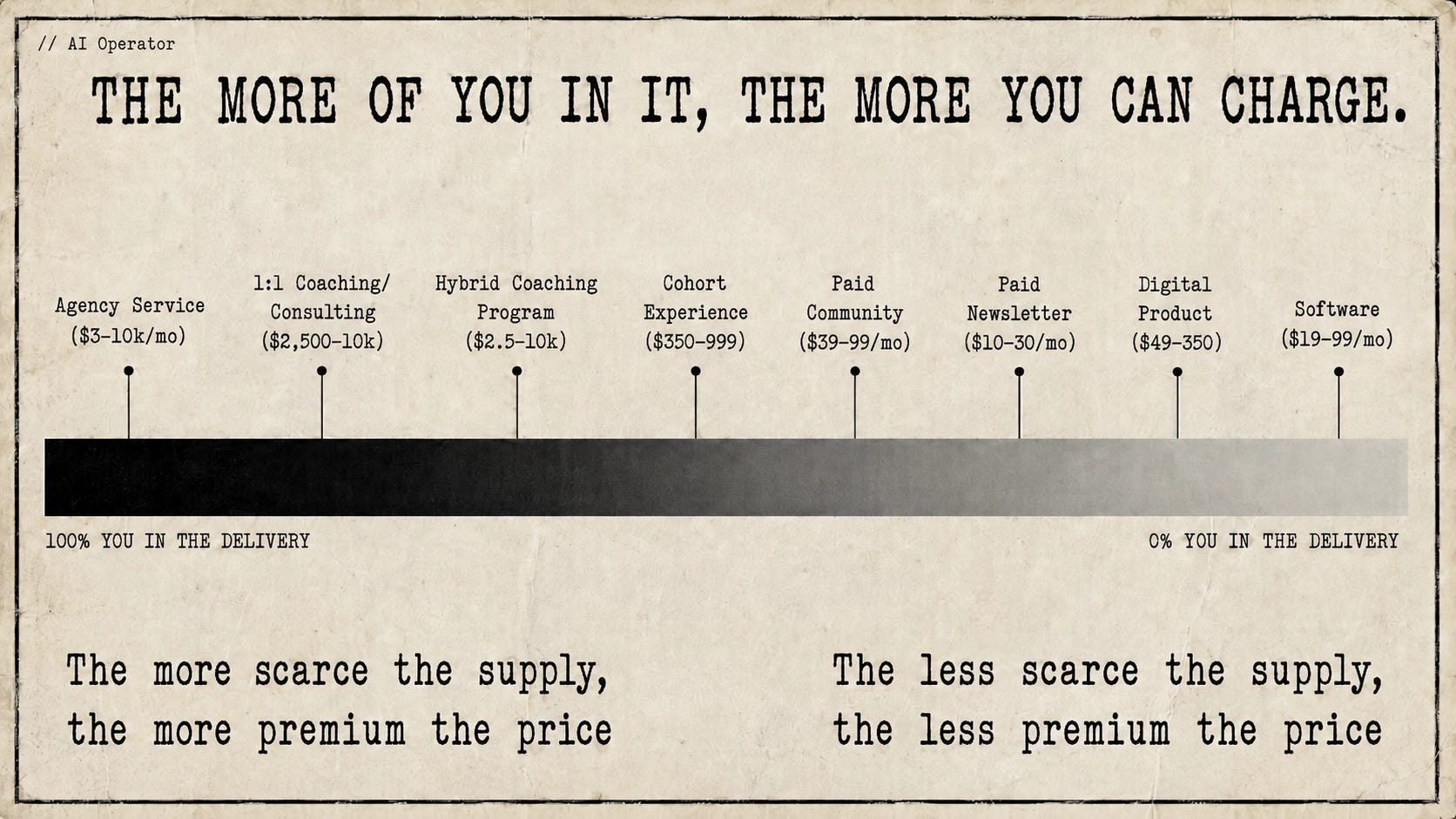
Every method in this guide sits on a spectrum of personal involvement from you (or someone, if you’ve hired yourself out of fulfillment).
On one end of the spectrum you have the done-for-you agency service - where 100% of what you are selling is something done by you (or someone else) for someone else.
On the other end of the spectrum, you have software — where 0% of what you are selling is from “you” showing up to deliver the service. The customer gets the same value whether you’re awake, asleep, or on the beach. Nothing about the delivery requires a human showing up.
And the rest of the methods sit somewhere in between.
Now, on this spectrum, price tracks involvement almost perfectly.
The least expensive is usually in the form of a software subscription. The most expensive is in the form of 1:1 coaching/consulting.
Why is this?
When involvement is high, the customer gets personalization and accountability. There is a physical cap on how many people can have it, and that scarcity drives price higher.
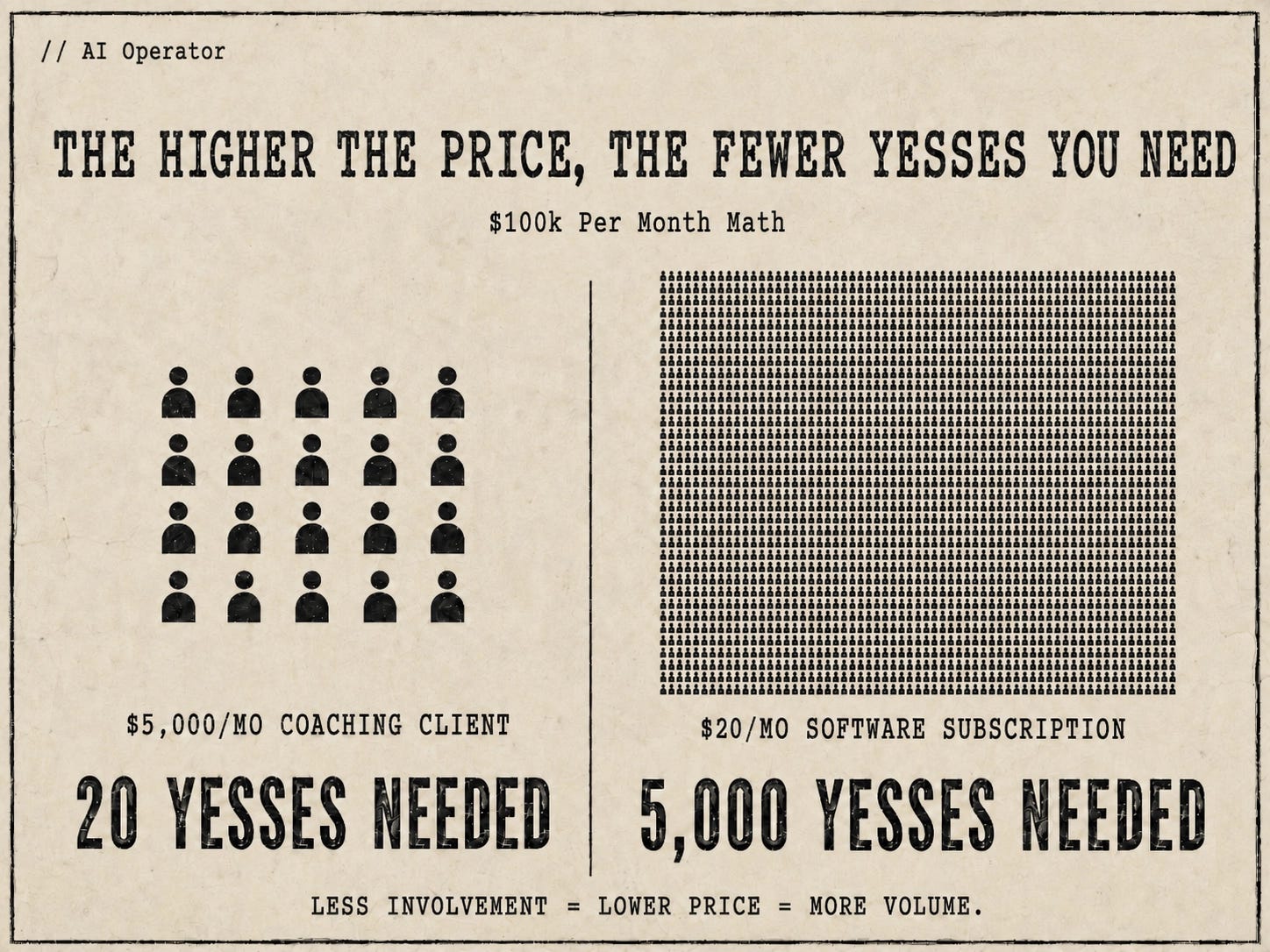
Now the flip side of this: high price (and high involvement) means you need fewer people to say yes to reach a certain level of income.
To reach $100,000 per month with a $5,000 per month service, you need 20 people to say yes.
To reach $100,000 per month with a $20 per month software subscription, you need 5,000 people to say yes.
So as we walk through these methods, keep in mind that you are trading less involvement for a lower price, which means you must make it up with more volume.
5. All Methods Start With Near 100% Margin — But Only A Few Keep It At Scale
At $10,000 per month, every method on this list runs at 90%+ margin. It’s just you, your time, and a few software tools.
But the thing to realize here is you’re simply getting paid for doing multiple jobs that you may, depending on the method, eventually need to hire out if you want to keep growing.
If you fast forward to what is required to do $100,000 per month in revenue with each method, it splits into two camps:
The margin keepers: digital products, paid newsletters, software, cohorts, and communities. Growing these usually just means more traffic & more customers, not more people on your team. You may need to invest in some people to help you generate more traffic or increase your pace of product production, but margin can hold steady at 70%+ at this level, and even higher if you keep doing everything yourself.
The margin givers: agencies, consulting, and coaching programs. Scaling means adding sales teams, fulfillment teams, operations teams to handle the increased complexity, and increased cost of continuous acquisition to keep your expanded capacity well-fed. You may be able to use AI to handle some of these things, but your margin likely compresses down to 30-50%, depending on how well you operate.
Now again, none of these methods are right or wrong. But most people step into a method, experience the benefit of its high-margin beginnings, and think that will maintain at scale. So it’s worth understanding how each of these methods change as they scale, which we will cover in the methods section.
6. All 8 Run On The Same 3 Core Systems
Despite each method being a different way of making money, every business will require the same 3 things:
Marketing. Getting customers
Delivering. Fulfilling customers
Operating. Managing the processes to help you do the first two & stay in business
No matter the method, you can map the time you spend on a daily basis back to one of these three things.
However, each method has:
A different list of activities for each of these core functions
A different ratio for how much time you’ll spend doing each
For the different list of activities, compare marketing for a paid newsletter and an agency service. One involves writing a world-class newsletter that people can’t help but tell their friends about + creating social media content. The other involves cold outreach and sales calls. Both end up getting you new customers, but the activities are different.
For the different ratio of activities, compare how much one spends operating inside an agency versus a digital products business. One requires invoicing clients, paying contractors, running payroll, modeling churn, capacity, and cash flow, and creating documentation to develop an internal playbook. The other requires answering questions in the support inbox, making sure you can collect payments, and automating the adding of someone to the course portal. Same category of work, but a completely different amount of time spent.
We will compare these differences at the end of the method section.
7. All 8 Can Run On The Same Simple Marketing System
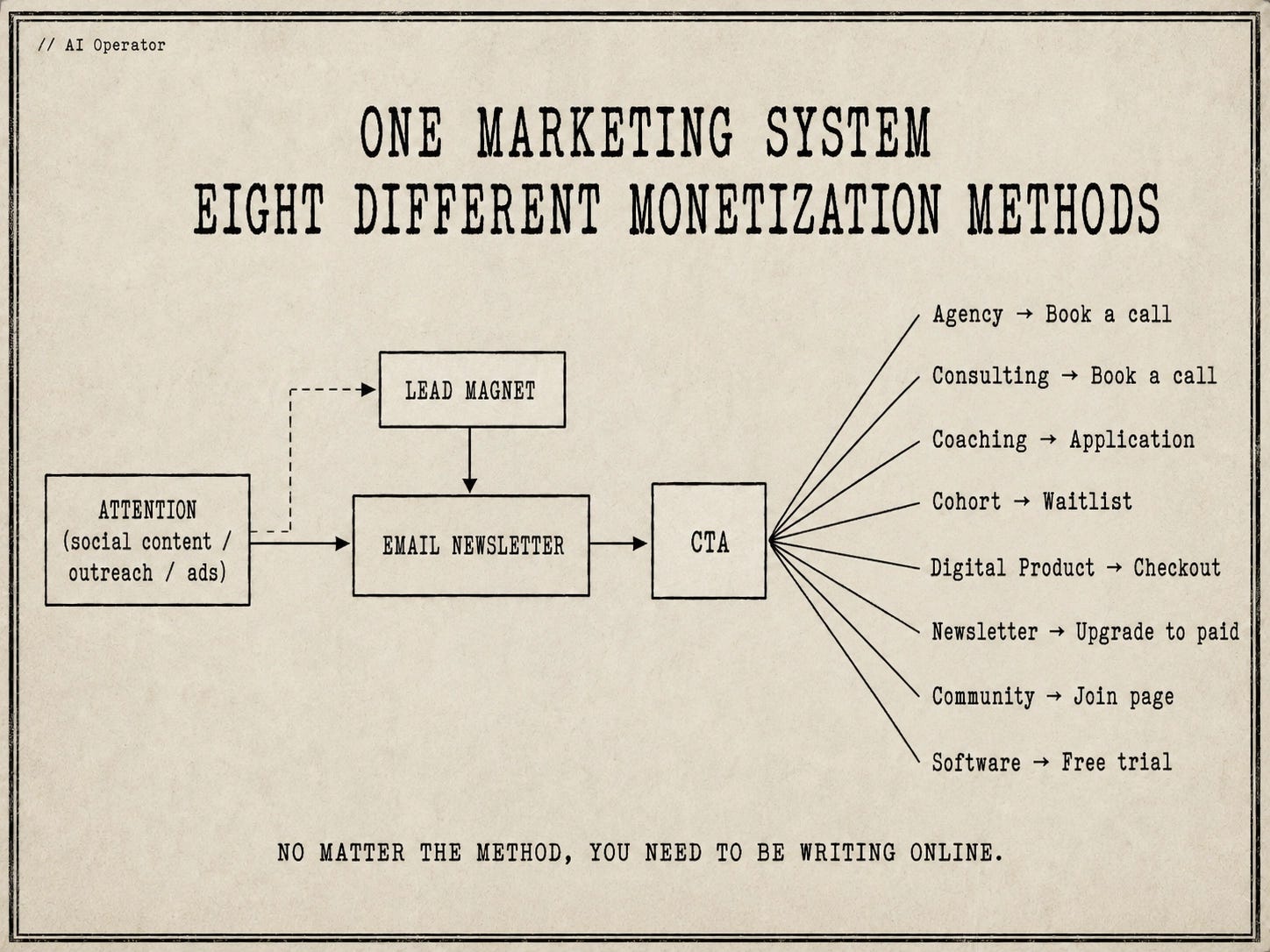
I added the “can” to this one, because there are many ways to run a marketing system for each of these.
However, we have run each of these on the back of the same simple marketing system:
Attention (social content/outreach/ads)
Drives to lead magnet
Drives to email newsletter
Drives to a CTA
The only thing that changes, depending on the method, is the last step.
For an agency/coaching program/consulting, the CTA in your emails is to book a call
For a cohort, the CTA is join the waitlist for the next cohort
For a digital product, the CTA is the product checkout page
For a paid newsletter, the CTA is to upgrade from free to paid
For a community, the CTA is the join community checkout page
For software, the CTA is to start a free trial
Which means no matter the type of business you want to run in the future, you need to be doing two things:
Writing on a social platform
Writing a newsletter
And to be fully transparent, this is the one thing I AM selling you on. Writing online and building a newsletter is exactly what we help set up first inside AI Writing Skool because none of these 8 methods work without those two foundational skills. If you want a deeper dive on either, I’ve written full guides on social traffic and newsletter which you can read later.
8. The Skills Transfer And The Methods Stack — But You Can Only Build One Piece At A Time
Now, here’s the good news that will take the pressure off this entire decision.
Every skill you build operating one method will transfer to the next.
Building an audience
Interviewing a customer
Creating a funnel
Pricing a service
Running payroll
Creating curriculum
None of these skills are wasted. They all can be immediately reapplied to a different method should you decide to switch.
On top of that, you can run multiple methods at the same time. And any good money model will involve elements of multiple methods over time. A community can sell digital products. An agency can add consulting on top. A cohort can run a community on the backend.
However, you can only build one of them at a time. Our entire business is a stack of all 8, but it took 6 years to build them and figure out how they fit together. And if we tried to build all of them at once, we would have failed to build any of them.
So rather than try to pick the perfect method from the beginning, the best thing you can do is make your best guess at which is best for you and your situation, then go all in on that method. Trying to build two at the same time will not work. You need to immerse yourself in everything you can to build the one method you are focusing on. Once it is up and running, sustainably, you can start to explore something else.
Put simply, there is no wrong choice on this list. The only wrong choice is spending another 6 months deciding.
The 8 Monetization Methods
Now that you understand the 8 Monetization Principles, it’s time to dig into the 8 Monetization Methods.
We are going to walk through 8 different methods:
Done-for-you Agency Service
1:1 Coaching/Consulting
Hybrid 1:1 + Group Coaching
Cohort-Based Experiences
Digital Products
Paid Communities
Paid Newsletters
Software/SaaS
And for each of these methods, we are going to cover:
What it is
How we run it
The math to $10k/month
The math to $100k/month
The metrics that matter
Your 3 priorities
Pros of this method
Cons of this method
It’s for you if…
It’s not for you if…
How AI changed this versus a decade ago
Playbook to run this method
Now throw your learning hat on and let’s dive in.
1. Done-For-You Agency Service
What It Is
Clients pay you to do the thing for them. You deliver a finished product to them either on a 1-off or recurring basis.
This is the easiest first sale of all of them because the client carries zero execution risk. They do not have to learn anything, do anything, or change anything. You plug your solution directly into their already-running business.
Examples of this include:
Design services
Ghostwriting services
Media buying services
Video editing services
Lead generation services
Static ad production services
Anything where you exchange a finished product for a fixed price.
How We Run It
Velocity — our done-for-you email marketing agency. We write newsletters, launch emails, and educational email courses for the clients we work with.
The Math To $10k/mo
2-3 clients at $3k-6k/mo retainers
This can be done fully solo with no team and minimal tools. You are just selling your time (as you are doing every role inside the business)
Note* do not charge less than $3k/month for any ongoing service, that is the floor
The Math To $100k/mo
10-20 clients at $5-10k/month — higher because trying to get to $100k/month on $3k/month clients is more challenging versus raising your prices first
Forced team additions of someone to help deliver, someone to manage accounts, and/or someone to generate new business. If you are extremely skilled with AI, you can likely get here on your own, but it will be challenging
As you scale toward $100k/month in revenue, you will see margin compress from 90% to 40-50%, depending on how lean you operate the team. Again unless you are extremely skilled with AI, which would allow you to maintain margins
At $100k/month, you are no longer spending your time as a service provider directly with clients. You’re running a people management & process management business that sells a service. Your day to day looks significantly different as you have likely outsourced entire parts of the business that you once ran.
Metrics That Matter (Monthly)
Total cash collected
New clients closed
Churn rate / churned clients
Calls booked
Outbound volume
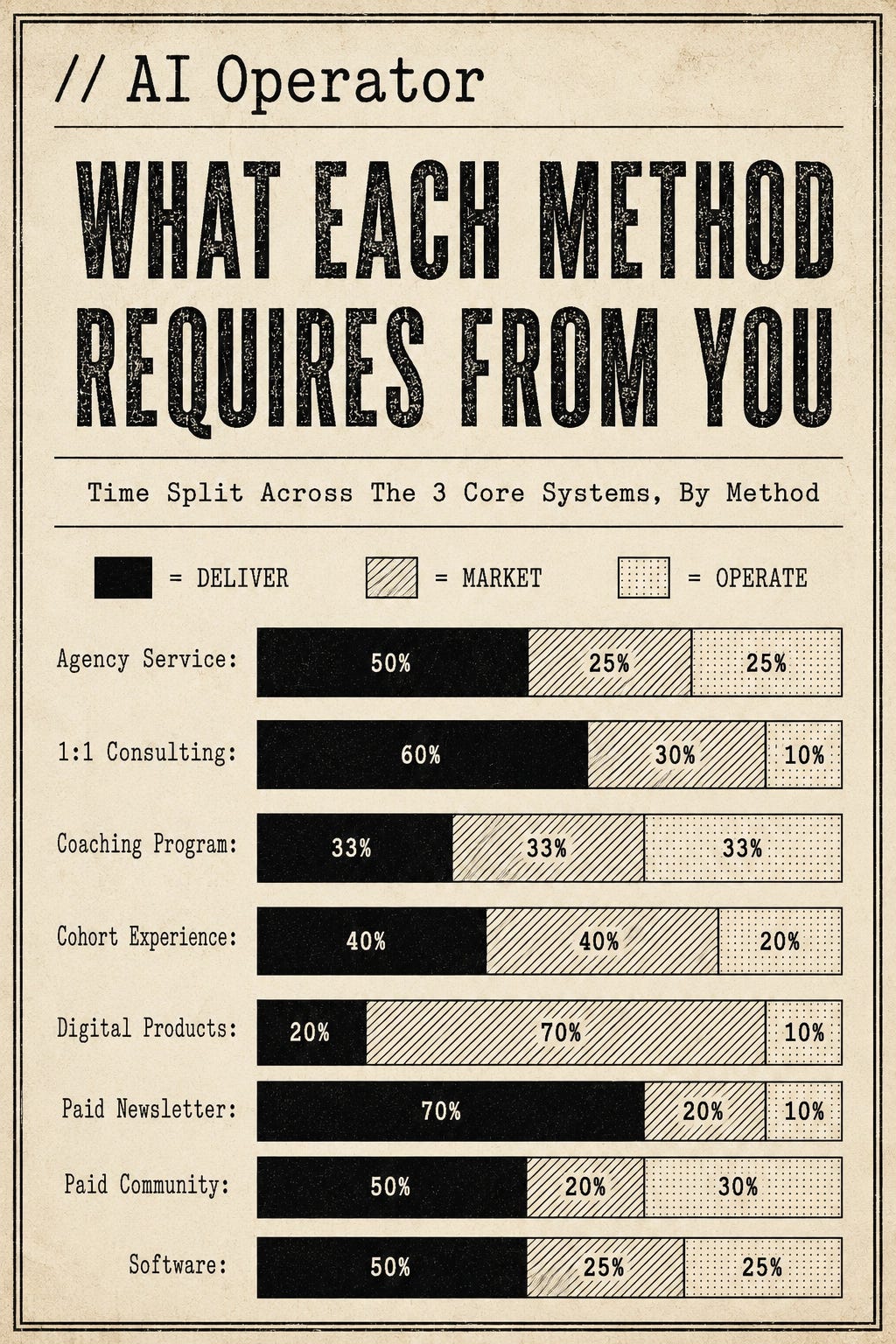
Your 3 Priorities (50% Deliver / 25% Market / 25% Operate)
Deliver excellent service. Delivering the work, on a deadline, with a high-quality standard is what keeps a client paying. Churn happens only when a client feels forgotten or underprioritized, so proactive communication is a big part of delivery.
Fill the pipeline. No matter how much fulfillment you have, you need to always fill the pipeline. Churn is going to happen no matter what, and the worst time to start outreach is the week a client leaves
Keep the lights on. Finance, invoicing, account management, hiring as needed, creating internal efficiencies, etc. This is an operations-intensive business no matter the size.
Pros of this Method
Fastest path to $10,000 per month of all 8 methods, zero audience required
Recurring by default, as long as you do a good job with delivery
You get paid to see inside dozens of businesses. This builds your pattern recognition that becomes raw material for any other business you build later
Rewards those who enjoy executing something repeatable and productizable. Your ability to build efficiencies is what creates a profit engine
Cons of this Method
You have as many bosses as you have clients, which means you’re constantly listening to other people & navigating their emotions
You are constantly at war with scope creep, which means you need to set boundaries and defend them (without deprioritizing the client)
Scaling this beyond ~20k/month usually involves hiring and managing, which is a very different skillset and day-to-day job
You are going to be repeating yourself and doing the same things every day for a large majority of the time, which burns some people out
It’s For You If…
You need meaningful income in the next 60-90 days from your online business
You want to build a stable foundation that lets you survey the entire online business landscape
You’re organized and reliable under recurring deadlines
You enjoy repeating and refining the same type of service
It’s NOT For You If…
You do not enjoy being told what to do / “working” for someone else. Every client you have is partially an employment relationship
You are someone who needs a large amount of novelty day to day
You want to build an asset that pays you while you sleep. With an agency, you are fundamentally trading time for money (but it doesn’t have to be your time, it can be someone else’s if you build a team)
You want time freedom from day one. Going off the grid when you run an agency will marginally increase the likelihood of churn for every client
How AI Changed This vs. A Decade Ago
Solo capacity has roughly doubled. One person can now handle 8-10 clients themselves by removing the lowest-leverage tasks from their days with AI. This means 30-50k/month 100% solo + AI is possible
Some clients think AI will be able to deliver the service you’re offering for 1/10th of the cost, so you are forced to better articulate your value & educate the client on the downsides of fully outsourcing to AI
Playbook (Funnel / Pricing / Sales / Fulfillment)
Funnel: 1) Cold outreach + free consulting → sales call → delivery or 2) Content + newsletter → sales call → delivery
Pricing: retainers framed as projects with a defined outcome and timeline, $3k/mo floor, ideal $6k/mo+
Sales: 1:1 sales calls with you taking the calls
Fulfillment: solo = you + AI doing the writing & operating. As you scale, you will hire yourself out of either writing, operating, or sales.
2. 1:1 Coaching/Consulting
What It Is
Selling your judgment & time directly, by the hour, the engagement, or a monthly advisory container. There’s no group, no curriculum, and no defined transformation. Someone has a problem and they pay you to think through it with them.
Compared to an agency service, this requires a higher expertise bar. The agency client receives finished work with nothing required from them. A consulting client has to take your advice and implement it themselves, and still get the result. Which means you need to have a higher level of mastery on the topic to be able to communicate it in a way they can implement.
How We Run It
We currently do not sell our time directly. If we did, it would be priced at least $2,000 per hour. We do plan on adding this type of consulting to our money model over the next few months, as more and more people are looking for our specific advice on their higher-level business problems.
The Math To $10k/mo
20 sessions at $500 per hour, or 2-3 advisory retainers at $3-6k/month
Sellable as soon as you want it to be with no leverage required
In practice, this is rarely a standalone business. It works best as a sweetener on top of another method, ideally as the highest price item on your menu for people who want direct access to you
If you choose this path, double the hourly rate you think your time is worth. Every engagement will have prep before, follow-up after, and take up some of your mindshare even when not on the call
The Math To $100k/mo
This method will rarely get here on its own. $100k/month of pure consulting (with no group container, service element, community, or other products) would be 50-60+ hours of calls per week, unless you’re able to charge $5,000+ per hour or more. But to be able to do that, you likely have a lot of other money methods going on
A realistic solo ceiling is 10-25k/month if you have very strong demand already
This method becomes more lucrative the more you’ve accomplished, because the amount you can charge scales with your experience.
Metrics That Matter (Monthly)
Cash collected
Engagements sold
Effective hourly rate (total cash / total hours including prep & follow-up)
Free strategy sessions booked (15-30 minute calls where you do a little free consulting to show them how you can help)
Your 3 Priorities (60% Deliver / 30% Market / 10% Operate)
Deliver. Show up sharp to every call. Your reputation is built or lost one conversation at a time.
Prospect. At this scale it’s mostly creating content that demonstrates your expertise with a CTA to work with you on a 1:1 basis
Operate. This is the lightest ops load of all 8. You can have the entire hosted with a paid Calendly link + a Notion page for each client
Pros of this Method
Near-total time freedom. You decide the hours, the clients, and how much you want to work
Lowest complexity of all 8 to start → Calendly link + Notion docs
Lowest complexity of all 8 to fulfill → just you and the client directly
You get paid to gather market research for something that you could launch with more scalability
Cons of this Method
There is a hard ceiling. Income is hours x rate, and both are limited, which means this can never be a large business on its own
Revenue is directly tied to your time. When you stop, revenue stops, which means every month starts near zero unless you’ve stacked retainers
Demand is often lumpy, which means it’s hard to forecast your earnings
Nothing compounds, unless you are deliberate in capturing your calls and turning them into a consumable/asset others could buy in the future
It’s For You If…
You have expertise people already ask you about for free. This method allows you to get paid for conversations you’re already having
You want maximum income per hour worked with minimum business complexity
You’re using it deliberately, either as a sweetener on top of another method, as the research phase before building something scalable, or as a way to keep income going with the minimum number of hours worked
It’s NOT For You If…
You’re trying to build a scalable business to take your income to $100k/mo+
You do not have expertise worthy of charging a premium price. This method doesn’t work at low rates because there is no volume lever to make up for it
Inconsistent income stresses you out. This is the lumpiest of all 8, unless you build a consistent content engine
You don’t enjoy thinking on your feet live. There’s no product or curriculum between you and the client, so you need to be able to make evaluations in real-time.
How AI Changed This vs. A Decade Ago
Generic advice is no longer billable. Anything a client can get from a chatbot, they will. What they still pay for is contextual judgment. What to do in their situation, with their constraints, from someone who has seen the pattern before
One consultant can now do what used to take a small firm. AI handles the research, analysis, and prep work, which means the effective value of an hour of real expertise has gone up
Playbook (Funnel / Pricing / Sales / Fulfillment)
Funnel: a single “work with me” page with a calendar link and a named offer. Naming the engagement (”Power Hour,” “Strategy Sprint”) makes it concrete and supports the price
Pricing: premium per-hour or flat per-engagement, with retainers for ongoing advisory. Don’t discount the hour. Reduce the scope instead
Sales: the lightest motion of all 8. DMs, email, free strategy sessions, then the calendar link
Fulfillment: calendar + video calls + a notes and follow-up system. That’s the entire stack, and keeping it that thin is the point
3. Evergreen Coaching Program (1:1 + Group)
What It Is
A transformation program. A defined outcome over a defined timeline, usually delivered as 1:1 coaching inside a group container. The client does the work while you provide the roadmap, feedback, and accountability.
This is not selling hours (that’s consulting), and not group-only teaching (that’s a cohort). It’s the hybrid in between, and it commands the highest ticket of the education methods. Evergreen means enrollment is always open with no launch windows.
How We Run It
Premium Ghostwriting Academy. Our 16-week program taking people from zero to landing their first $3-5k/mo ghostwriting clients. 1:1 coaching inside a group container. The highest-ticket offer in our portfolio.
The Math To $10k/mo
2 enrollments/mo at $5k, or 4 at $2.5k
The prerequisite here is not audience size. It’s having a ton of proof you can deliver a result plus a sales motion to enroll people. Both of these require time, which means this is not a business you can start this week
The Math To $100k/mo
~20 enrollments/mo at $5k, which requires paid traffic or a large audience, a setter, a closer, and likely coaches delivering under you
To get here, you will need to remove yourself from either delivery or sales management. One of them has to run without you. Keep coaching and hire out the sales function, or run the sales function and hire coaches trained on your method. Trying to hold both seats will stall you out in the $30-50k/mo range
This method can scale to $200-250k/mo with a relatively lean team, because coaches can fulfill multiple clients. Headcount grows slower than revenue compared to an agency because coaching/giving feedback is more scalable
Metrics That Matter (Monthly)
Cash collected
New enrollments
Calls booked
Show rate
Client result rate (this drives testimonials, referrals, and your close rate 6 months from now)
Your 3 Priorities (33% Deliver / 33% Market / 33% Operate)
Deliver. Coaching calls, feedback, unblocking students who are stuck, and turning every question you answer twice into curriculum, so delivery gets more efficient over time.
Market. Filling the sales calendar through content, ads, and a choreographed funnel. Managing the sales team & coaching them to improve, day in and day out. At scale this is a marketing & sales operation that requires a significant amount of sustained effort
Operate. Enrollment ops, contracts, payment plans, client tracking, coach hiring and QA, sales team management. This method includes the highest number of relationships between students, coaches, and team members, which makes it the most operationally-intense.
Pros of this Method
Scalable to $100-250k/mo with a lean team. Among the best revenue-per-person of any method on this list
High margin when you already have an audience, because owned attention keeps your acquisition cost low. Without one, paid acquisition will run at about 20-25% of your revenue, which thins out your margin from the very beginning. This method is best when running ads on top of an already-strong organic presence
A repeatable process for each client. Same transformation, same milestones, same playbook, which means every cycle gets more refined
Cons of this Method
You’re selling an outcome you don’t fully control. Clients who don’t do the work still expect the result, which means part of the job is managing that gap and their emotional state
Revenue is tied to your calendar and to continuing to show up for calls. The presence requirement doesn’t go away at scale, it just changes shape
Revenue is also dependent on the sales team, and therefore their emotional state. If your sales team morale starts to deteriorate, you can lose 2 weeks of revenue before it turns around
There is no compounding revenue engine. You are constantly playing the game of finding more customers. Adding a recurring community on the back end helps, but even then churn runs high
The higher the ticket, the more involved the sales motion. And it gets heavier as you scale. Setters, closers, comp plans, call reviews, pipeline management, it becomes the majority of the complexity in the business, which some people will find exhausting to run over time
It’s For You If…
You have demonstrated the result for yourself so many times that there is no doubt you can help others do it. Not one win. A repeated pattern of wins. The proof bar here is the highest of all 8, because the price is also the highest.
Live conversations energize you, and you can hold people accountable without needing them to like you in the moment
You’re willing to build (or get good at) a real sales motion and continue to operate that motion day in and day out
You want the method that will force you to build the highest number of new skills of any of the methods
It’s NOT For You If…
You need income in the next 60-90 days. This takes meaningfully longer to spin up than a service, because trust, proof, and a sales system all have to exist first
Calls drain you. This is the most presence-dependent method of all 8, because clients are specifically paying to learn from you
You take client failure personally. Some percentage will not do the work, and that emotional cost adds up
You want an asset that grows in value without you in it or as the face of it
How AI Changed This vs. A Decade Ago
The information layer is now free, which means coaching that was just information delivery no longer sells. What people pay for now is accountability, personalized judgment, and someone who believes they can do it
Coaching capacity has expanded. AI can hold context on far more clients than you (or the coaches you hire) could alone, which means each coach can serve more people without quality dropping
Playbook (Funnel / Pricing / Sales / Fulfillment)
Funnel: content or ads → newsletter to VSL → application → book-a-call with testimonials & belief-breaking content sprinkled in at each step. The higher the friction of the purchase, the more proof the funnel needs
Pricing: price the transformation, not the time. Defined outcome, defined timeline, $2.5-10k range over 3-6 months
Sales: 1:1 sales calls. At scale, a setter books, a closer closes, and you (or your coaches) deliver
Fulfillment: a living curriculum, weekly group calls, 1:1 calls, and a group for the community to engage. Once you scale, coach hiring and QC of their coaching becomes a significant part of the day to day.
4. Cohort-Based Experience
What It Is
A time-boxed group program. Fixed start date, fixed end date, everyone moves through it together, live. No 1:1 layer. The information could live in a self-paced course. What you’re actually selling is the experience. Live sessions, deadlines, peer momentum, and the forcing function of a start date. Sold in enrollment windows, not evergreen.
How We Run It
Ship 30 for 30. Our 30-day writing challenge, which was our primary business for years and had zero coaching element. Live sessions, gamification, build-in-public mechanics, thousands of students per year at peak.
The Math To $10k/mo
One launch. 30 seats at $350, or 12 seats at $850 for a smaller premium cohort, or 5 seats at $2k for the most premium
This requires far more yesses than the first few methods. 30 buyers instead of 2-3 clients, which means you need an audience or a warm email list before this model opens up
Slower to first dollar than the service methods, but faster to meaningful revenue than evergreen digital products once you have any list at all, because you create scarcity & urgency which will pull a ton of purchases into the present
The Math To $100k/mo
~300 seats/mo at $350, or higher-ticket cohorts at lower volume
You will need a real launch system (waitlist building between windows, email launch sequences) and a delivery operation (session production, community moderation, support)
The structural challenge is that revenue arrives in spikes but your costs are monthly (if you have a team). At scale you either need to hire people on a fractional basis, add in a recurring community on the backend, or have digital products for sale in the interim to smooth out the spikes
At this level, most of your time goes to the launch machine and producing the live experience. The curriculum itself mostly stops changing, but you need to find new ways to communicate your ideas on the marketing front
Metrics That Matter (Per Launch, Rolled Up Monthly)
Cash collected per launch
Enrollments per launch
Enrollment conversion rate (units / email subs)
List growth between launches
Cohort completion rate
Your 3 Priorities (40% Deliver / 40% Market / 20% Operate)
Deliver. Producing the live experience. This includes a strong curriculum, assignments for each module, breakout room containers for students to meet one another, gamification to keep them going, and tons of energy poured into each live session.
Market. Building the waitlist between windows and executing the launch. Opening the cart happens every 6-12 weeks, but the launch is won or lost with how many new email subscribers you add during the period where you aren’t selling
Operate. Tech infrastructure for live sessions, building onboarding systems, live session replays & transcription, and making sure all student communication goes out at the right time.
Pros of this Method
Cohorts can generate 2-3x the amount of a digital products despite the same information. People will pay for a live experience that forces them to show up
Cohorts get people to actually finish. Deadlines and peers produce completion rates significantly higher than self-paced courses. And when people actually finish your product, they are way more likely to tell their friends
Cohorts are naturally seasonal. There are intense delivery windows followed by time with zero fulfillment, which creates a natural rhythm of marketing versus fulfilling
Cons of this Method
Your revenue is concentrated into a handful of launches per year, which means one underperforming launch can put a hole in the entire quarter. You will feel the pressure of this in the week before every single enrollment deadline
You cannot start this method without an audience or a warm email list. Doing “outreach” for someone to join your cohort is not going to work like it would an agency service.
Delivering live for multiple weeks is physically and emotionally demanding. Students can tell immediately when your energy dips. You will also be delivering the same session multiple times over multiple cohorts, yet it needs to feel like the first time for the people attending
Every cohort begins with an operational surge, which means onboarding dozens or hundreds of people in the same 48-hour window. Any broken system impacts your entire cohort at one time
It’s For You If…
You love teaching live and get energy from group momentum. The experience is the product, and you are a large part of the experience
You have (or are actively building) an audience and want to “beta test” the curriculum for a digital product. By running a cohort first, you can gather feedback that will make your future digital product much better
You prefer concentrated work seasons over an always-on obligation like an agency service or coaching program
You don’t mind adding marginal operational complexity for an increase in revenue (compared to just selling the same information as a digital product)
It’s NOT For You If…
You do not have an audience and you want revenue soon. You will not fill a cohort unless you have a 1000+ audience of people to launch to.
Performing on camera drains you. There is no low-energy version of a good cohort and you must show up at your best
You want smooth, predictable monthly revenue. This is the spikiest method of all 8, with big lumps happening a couple times per year
You’d get tired of delivering the same material live for the tenth time. This method rewards consistency and the ability to repeat yourself over constantly changing your curriculum message
How AI Changed This vs. A Decade Ago
The cost of producing curriculum has collapsed, which flooded the market with courses
That made the live experience more valuable, not less. Deadlines, peers, and shared momentum are things AI can’t generate, which means the experience premium has held up better than the information premium
Delivery ops got lighter. AI handles session summaries, follow-ups, and Q&A support, which means a lean team can now run a much bigger cohort compared to 2021
Playbook (Funnel / Pricing / Sales / Fulfillment)
Funnel: content + newsletter → waitlist page between windows → email launch drives people to checkout page
Pricing: $350-999/seat is the standard range. Premium and B2B cohorts run higher. Price climbs with brand, demonstrated results, or value of the problem you are solving
Sales: email launch with genuine urgency given the cohort starts on a specific date. The enrollment window does the closing. No sales calls needed under ~$1k/seat
Fulfillment: live session production + community platform + gamification and progress mechanics + onboarding waves.
5. Digital Products
What It Is
Packaged knowledge sold at a one-time price, delivered self-serve.
Ebooks
Swipe files
Prompts/skills
Online courses
Template bundles
Anything that is purely digital
Importantly, for each of these there is no live component, no cohort, and no access to you. The customer buys, logs in, and works through it themselves.
How We Run It
Start Writing Online plus our full product catalog. A suite of $99-350 products, each solving one specific problem for one specific person, cross-sold to each other through order bumps, in-product links, and post-purchase email sequences.
The Math To $10k/mo
29 sales/mo at $350, or ~60 at $175
The most yesses required of any method so far. And each yes comes from someone converting off a landing page alone, with no call and no launch energy to help. Which means your funnel is doing 100% of the selling
To generate 29 sales at roughly a 3% conversion rate of email subscribers, you need 1,000+ on your list for a $10,000 launch
The Math To $100k/mo
~285 sales/mo at $350. At scale, this becomes a function of two things. Audience size × new product creation. Your audience determines how many buyers each release reaches, and your catalog determines how many times each subscriber can buy
What’s required is a consistent audience-building engine and a repeatable product creation system. Shipping a new product every cycle to a list that keeps growing. If you stop either one of these, your revenue growth will flatline
What’s NOT required is headcount. This is the first method on the list where $100k/mo doesn’t need a team, as long as you’re able to generate that kind of demand from your content
Metrics That Matter (Monthly)
Cash collected
Units sold
Landing page conversion rate (buys / page visits)
Purchase to email sub conversion rate (buys / launch segment size)
New email subscribers
Your 3 Priorities (20% Deliver / 70% Market / 10% Operate)
Market. For a digital products business, this is basically the entire job. Audience building, funnel testing, email sequences, launches. You are running a marketing business
Deliver. Building products and keeping them current. This goes up when you are creating a product, then goes to zero if you are simply selling the product you’ve already built.
Operate. By far the leanest operation of all 8. Practically zero operations other than handling login issues, setting up automations, and answering your support inbox.
Pros of this Method
Build once, sell forever. The first method on this list where revenue is completely detached from your calendar.
Near-100% margin with no marginal delivery cost. Sale #500 costs you the same as sale #5
Scales without adding people, as long as your content can continue improving
Full location and schedule freedom once it’s running, meaning you can spend a week off the internet and still make money
Cons of this Method
No urgency by default. Evergreen products drift without launches, deadlines, and promos, which means you have to manufacture your own buying moments consistently throughout the year
It’s a volume business at low price points. Hundreds of buyers means thousands of visitors, which means the real business you’re in is generating traffic
Slowest first dollar of the methods so far if you’re starting from zero audience, since you have to both build the product and build the audience, each of which takes months
Refund requests and support tickets scale with volume. Even if it’s very small on a percentage basis, the “feeling” of 20 refund requests versus 2 refund requests is significantly worse, even if you sold 10x the number of units.
It’s For You If…
You want leverage over speed. You’re deliberately trading slower first dollars for revenue that doesn’t require your presence in the future
You enjoy (or are willing to get good at) marketing itself. Funnels, copy, audience building, identifying valuable problems to solve. You are basically becoming a full-time marketer
You’ve already proven the knowledge somewhere else. Ideally by delivering it live through a service, coaching, or a cohort, so you know exactly where customers get stuck and can translate that into a digital product
It’s NOT For You If…
You need income in the next 60-90 days while starting from zero
You think the product is the hard part. The product is 20% of the job, and if the other 80% (marketing) doesn’t interest you, this business won’t either
You don’t like repeating yourself. This method is saying the same core ideas in many different formats, products, and angles for years
You’ll resent making content indefinitely. No content engine means no traffic, which means no sales
How AI Changed This vs. A Decade Ago
Anyone can now build a course in a weekend, which flooded the market and ended the era where information alone was worth paying for
Which means the moat moved to distribution and proof. An audience that trusts you, and results that back you up. Those are the two things the flood of AI-generated products can’t replicate
The operations got even leaner. Copy drafts, email sequences, and support all run partially on AI now, which means you can operate with an even leaner team than before
Playbook (Funnel / Pricing / Sales / Fulfillment)
Funnel: social content → lead magnet → newsletter → checkout page. Order bump at checkout, upsell after to something 5x more expensive that 8-15% of your customers will take.
Pricing: $49-350 range. $350 is the practical ceiling for a standalone product. Above that, buyers expect live experience or access to you. Anything below ~$150 should be used as a means to sell something more expensive. Trying to generate significant revenue off a product at that price point only works if you have exceptionally high amounts of distribution
Sales: self-serve evergreen checkout + periodic launches (new products, promos) to create the urgency evergreen lacks
Fulfillment: course platform + payment stack + support inbox + email automation. Overall, the least amount of fulfillment complexity versus every other product
6. Paid Newsletter
What It Is
A recurring subscription to your ongoing written work. Readers pay monthly or annually for what you publish next, not for a finished asset. Technically a digital product, but the recurring revenue, publishing cadence, and churn dynamics make it a different business entirely.
How We Run It
Write With AI. Our Substack-based paid newsletter, one of the largest paid writing publications on the platform. Every issue delivers a tangible asset (a writing framework + the AI prompt to execute it), not just an essay.
The Math To $10k/mo
~500 paid subs at $20/mo, or a smaller base on annual plans ($150-300/yr). Having a good annual plan is the best lever to increase your cash collected.
Behind those 500 paid subs is a free list roughly 10-20x that size. The free list is what leads to the paid list. Paid conversion typically runs 2.5-10% of free, depending on the price point of the newsletter
More yesses than any method so far, but the smallest yes on the list. $20 is a low-consideration purchase that converts off trust and only a slight amount of demonstrated expertise
The Math To $100k/mo
~5,000 paid subs, which means a free list of 100k+ and a top-of-funnel system running constantly to get new free members on the list.
What’s required is a real growth engine (social content, cross-promotions, recommendations) and retention systems to upgrade to annual or keep people paying monthly. At 5,000 subs, 5% monthly churn means replacing 250 subscribers every month just to stay flat. Put another way, you will shrink every month if you are unable to match your churn with new subscribers
Similar to digital products, you do not need to add headcount. A writer/operator plus part-time growth help can run this at scale, which means margin stays very high
Metrics That Matter (Monthly)
Cash collected (MRR + annual)
New paid subscribers
Free list growth
Free → paid conversion rate
Churn rate
Your 3 Priorities (70% Deliver / 20% Market / 10% Operate)
Deliver. Shipping the flagship issue every week at a quality bar that makes renewing an easy decision. In this model, delivery is also most of the marketing. Great issues get shared, screenshotted, and forwarded, which means the newsletter itself does double duty
Market. Growing the free list through social content, cross-promotion, and lead magnets. The paid tier only grows as fast as the free tier feeds it
Operate. The leanest ops of the recurring methods. Platform admin, payment issues, the occasional refund, but overall very little to keep the lights on.
Pros of this Method
Recurring revenue that compounds subscriber by subscriber. No launches required, as long as growth outpaces churn
The deepest trust channel of all 8. Someone paying to read you every week is your warmest possible audience, which means a paid newsletter makes it easier to launch any other method in the future
Forces you to produce a weekly asset. The publishing cadence generates frameworks and material that feed your products, bootcamps, and social content
Essentially zero costs, other than platform fees. One person can run a seven-figure paid newsletter
Cons of this Method
The publishing commitment never ends. A subscription is a promise of next week, forever, which means skipped weeks show up directly in your churn
The churn math is unforgiving at low price points, which means you need a consistent flow of new subscribers just to stay flat, and even more to grow
It only works in certain niches. The topic needs to be either fast-moving or very deep, otherwise you run out of newsletter topics
Trust builds slowly. Readers only upgrade after you’ve proven you show up every single week, and there is no way to speed that process up
It’s For You If…
You genuinely enjoy the writing itself. The weekly rep is the job, and it never stops
You can hold a cadence for years. Consistency is the entire moat
Your niche moves fast or runs deep, which means there’s always a next issue worth paying for
You’re playing a long game and want the trust asset that improves everything else you’ll ever sell
It’s NOT For You If…
You write in bursts, rather than on a consistent basis. Inconsistency hurts here more than in any other method
You need income soon. This is among the slowest methods to meaningful revenue from zero
Your topic is settled knowledge. If the definitive version can be written once, it’s a digital product, not a newsletter
A weekly deadline with no end date sounds draining rather than energizing
How AI Changed This vs. A Decade Ago
Curation newsletters are done. Rounding up links has no value when AI does it instantly
Experience became the defensible layer. Readers pay for proof you’ve actually done the things you’re writing about, because the information itself is now free
Production has accelerated for people who have something real to say. Research, drafting, and editing all compress, which means the gap between operators and curators keeps widening
Playbook (Funnel / Pricing / Sales / Fulfillment)
Funnel: social content → lead magnet → free newsletter → paid upgrade CTA. The upgrade pitch runs continuously (locked posts, teasers) plus periodic discount windows
Pricing: $10-30/mo standard, with a strong annual anchor. Premium tiers work when issues deliver usable assets that a regular paid subscriber does not get
Sales: fully self-serve. The writing is the sales team. Launch-style promos 2-4x per year add urgency to an otherwise evergreen motion
Fulfillment: the platform (Substack/beehiiv) + your weekly production system. Write the newsletter every week, that’s your only job.
7. Paid Community
What It Is
A recurring membership built on three layers.
Education with ongoing content unlocks
Live experiences (calls, events, challenges)
And member-to-member connection
Think of it as part paid newsletter, part digital product, and part cohort. Combining them creates a vehicle with the opportunity for high recurring revenue, at the cost of high recurring work.
How We Run It
AI Writing Skool. Our Skool-based membership at $99/month or $800/yr, with a product catalog inside, live workshops, and multiple levels of access depending on what the student needs.
This is the core growth vehicle of our portfolio right now and where we are most excited for the future.
The Math To $10k/mo
~250 members at $39/mo, ~100 members at $99/mo, or ~150 on annual at $800/yr. Same revenue, very different communities. The $39/mo version needs more volume and churns faster. The $99/mo version needs stronger proof to sell but filters for committed members, and committed members are what make the community valuable
Starting a community from scratch is hard. A community’s value is invisible below critical mass. 20 people in a quiet community is a worse product than no community, which means this almost never works as a first method. It works as a layer on an existing audience or customer base that leads it to fill up quickly.
Annual pricing matters even more here than in newsletters. It reduces churn by locking members for a year and filters for the members who make the community good
The Math To $100k/mo
1,000 members at ~$100/mo equivalent. Or you use the community as a base layer and add live experiences, bootcamps, or 1:1 consulting on top, increasing the LTV of each member instead of chasing raw member count. Two paths to the same number. Add more members, or increase the value and price of what each member buys
At $100k/mo, you are engineering retention systems as much as you are creating new content and continuing to show up.
Your role shifts toward programming and systems design. Creating the conditions where members generate value for each other, delivering ongoing new value, and creating paths that keep members moving for more than the first month
Metrics That Matter (Monthly)
Cash collected
Total members
New paying members
Churn
Activation rate (% of people who complete onboarding)
Community engagement rate (% of people who post something)
Your 3 Priorities (50% Deliver / 20% Market / 30% Operate)
Deliver. Programming the calendar. Workshops, challenges, content drops, live events. The rhythm that gives members a reason to show up this week
Market. Driving more people to the product page to grow the community.
Operate. The heaviest ops load of all 8 relative to revenue. Onboarding flows, activation sequences, moderation, member success, platform management. Given you are selling something on an ongoing basis to a lot of people, the ops load scales compared to something like a digital product.
Pros of this Method
Recurring revenue. $39-99/mo is sustainable B2C, and B2B communities run up to $1,000/mo
The community creates value you don’t have to make. At critical mass, member answers, connections, and wins carry a growing share of the load
The deepest moat of all 8. Content can be copied in an afternoon. Community ties can’t, which means members stay for the people even when they could get the content somewhere else
The perfect foundation layer for other methods to plug into. Every other method on this list connects to it as a tier, an upsell, or an entry point
Cons of this Method
The heaviest ongoing ops load per dollar of revenue of all 8. Events, moderation, activation, member success. None of it is optional and none of it is ever finished
Recurring revenue means recurring obligation. The community expects this month’s programming regardless of your energy or what else the business needs
A quiet community dies visibly, in front of its members, which accelerates the decline
Engagement decays by default. Every community trends toward quiet without consistent programming energy, which means you have to manufacture student engagement
It’s For You If…
You’re genuinely energized by people and their wins, and you enjoy the daily reality of engaging with members
You think in systems and rituals. Recurring events, traditions, gamified progress
You already have an audience or customer base to seed critical mass. This is a second or third method, almost never a first
It’s NOT For You If…
You want anything resembling passive income. This is the least passive recurring revenue there is
You do not have an audience. Starting a community without a base of people who have already bought from you can be challenging
Moderation, member drama, and ongoing ops sound draining. You will spend a lot of time dealing with people
You’d rather teach than facilitate. If you want to be the one presenting rather than the one hosting, a cohort is a better fit
How AI Changed This vs. A Decade Ago
Information is now free everywhere, which means belonging and accountability became the scarce goods. The community’s value moved entirely to the human layer
AI now runs a large share of the ops. Onboarding sequences, engagement tracking, activation nudges. Which means a lean team can operate a community that used to require staff
But AI cannot be the reason people stay. Connection is the one deliverable that can’t be generated, which makes this both the hardest method to run and the hardest to compete away
Playbook (Funnel / Pricing / Sales / Fulfillment)
Funnel: content + newsletter → free taste (an open event, challenge, or trial window) → membership checkout. Communities sell best when people experience it before buying it
Pricing: $39/mo or $99/mo are typical B2C price points, with a strong annual anchor ($400-800/yr). B2B runs to $1k/mo. Escalating tiers on top is where the larger revenue lives (selling more access to you)
Sales: self-serve joins + periodic enrollment pushes. Higher tiers warrant a call if it’s more than $1,000 per month
Fulfillment: the platform (Skool) + event calendar + activation flow + moderation system. The first-7-days activation sequence is the highest-leverage system in the method. If you can get someone through the first week, then the first month, the likelihood they churn goes down significantly
8. Software/SaaS
What It Is
A product that solves the problem itself. No information to consume, no transformation to complete. The tool does the work, and customers subscribe to the outcome. This is the only method of the 8 where what you build delivers value without you (or your knowledge) showing up anywhere in the experience.
How We Run It
Ghostbase. SaaS built with a third partner, sold into the same audience our education products serve. The newest and slowest-building layer of our portfolio, and we are deliberately patient with it.
The Math To $10k/mo
~525 users at $19/mo, ~250 at $39/mo, ~100 at $99/mo, or ~10 accounts at $999/mo. Same revenue, very different products and support loads. Cheap-and-wide vs. premium-and-narrow is the first decision you will make in building your software
The most yesses of all 8 at consumer pricing, and the slowest ones. Before anyone can subscribe, the product has to exist, work, and matter. Every other method can collect money before it’s fully built. Software cannot
From a standing start, expect months of building before the first dollar
The Math To $100k/mo
~2,500 users at $39/mo, or a blended mix at higher price points
What’s required is support systems, infrastructure that doesn’t break when more people join, discipline to work on the most important features, a constant battle against churn. Every month starts with a group of people who will leave that you have to outgrow before you add any net new revenue
What you get in exchange is enterprise value. Software is the one method on this list that sells for a real multiple of revenue, because the value of the business is not tied to you personally being in it
Your role becomes running a product company. Prioritization, reliability, and retention. Your expertise is embedded in the tool rather than performed by you
Metrics That Matter (Monthly)
Cash collected (MRR)
New paying users
Churn
Activation rate (% of signups who reach the moment where the product’s value clicks)
Your 3 Priorities (50% Deliver / 25% Market / 25% Operate)
Deliver. Building what users actually ask for, fixing what breaks, and saying no to most of the roadmap
Market. Driving trials and signups. For us, distribution rides our audience and ecosystem, which is the main advantage that makes creator-led SaaS work at all
Operate. Support, billing, infrastructure, uptime. The ops never fully stop, because the product is up all of the time
Pros of this Method
The purest leverage of all 8. The marginal cost of the next customer is roughly zero, and the product works during every hour you don’t
The only method with real enterprise value. A sellable asset at a multiple, not just an income stream
Compounds without your presence. No calendar, no cohort, no weekly publishing obligation, as long as users are bringing their friends
Strengthens every other model in a stack. A tool your community, students, and readers use daily is retention infrastructure for the whole ecosystem
Cons of this Method
The slowest time-to-first-dollar of all 8, by a wide margin. And the only model where you can invest months and earn nothing if the product isn’t something people want
The default outcome is building something nobody uses. Basically all software dies, but slowly over time.
Support and maintenance never end. Bugs, billing issues, platform changes. Shipping v1 is the start of an ongoing obligation to keep things going.
There is upfront cost, even if you vibe code the V1. You need either capital, a technical partner, or the patience to build across a long unpaid runway before you have something that people are willing to continue paying for
It’s For You If…
You have a long time horizon and income from somewhere else, because this bet requires the most patience of all methods
You enjoy product iteration. Shipping updates, watching how users respond, and improving from there is the actual day-to-day
You already have an audience that has told you, repeatedly and specifically, what tool they’re missing. Which removes most of the risk of building something nobody wants
It’s NOT For You If…
You need income this year from this method. Any of the other 7 will get there first
You tend to lose interest after launching. Software punishes people who build and then don’t iterate harder than any method on this list
You have no audience AND no capital. Building the product and the distribution at the same time from zero is the hardest possible version of this game
How AI Changed This vs. A Decade Ago
This is the method AI changed the most. A non-technical solo founder can now ship a working product. The build barrier that gated this model for decades is mostly gone, which means there is more mediocre software in the world than ever before
Now the moat has gone from “can you build it” to “can you distribute it.” Everyone can build now, so the person who owns an audience beats the person who’s the better engineer
Support and ops are partially automated. AI absorbs the first layer of support and admin, which means a 1-2 person SaaS is genuinely viable at scale for the first time
Playbook (Funnel / Pricing / Sales / Fulfillment)
Funnel: content + newsletter → free trial or freemium tier. The product demos itself. Your job is driving qualified trials
Pricing: $19 / $39 / $99 / $999/mo are the archetypal tiers depending on who you serve. Seat-based for B2B. Annual anchor, same as every recurring model
Sales: self-serve for B2C. Demo calls once B2B contracts are involved
Fulfillment: the product is the fulfillment. The actual job is the roadmap, support system, and infrastructure behind it. The best fulfillment happens when you build what customers ask for, not what you personally find most exciting to build
Frequently Asked Questions
After reading about these 8 methods, chances are you have some unanswered questions. Here’s my best attempt at answering them proactively.
1. “If you started from scratch today, what would you do?”
For the sake of simplicity, I am going to assume I have a full-time job that gives me a stable income foundation. And I will assume I have zero pre-built audience on any platform.
In that scenario, my exact process would be:
Start writing online on one social platform. I would stay here until I’ve had 30 days consistently posting every day on that platform
Start a newsletter, while continuing to write on my social platform. Publish on a weekly cadence, staying here until I have kept my social writing cadence + written a newsletter for 6 straight weeks
Once I am doing those two consistently, I would look to offer an agency service. I would do outreach & free consulting until I had 2 clients on retainer in the $3-$6k/month range
At this point, I have a compounding organic engine (writing social content + a weekly newsletter), plus two clients paying me to provide a service.
At this point, I have the best possible foundation to go pursue any other path.
I could choose to scale up my agency service, trading more time for money
I could keep the income of my agency clients and invest more into my content and personal newsletter to grow my audience
As my audience grew, I could take the lessons I’ve learned working with my clients and distill it into a cohort-based experience that I take a handful of new clients through
I could then distill that cohort into a digital product, or I could repeat the cohort on a consistent basis
Or I could ignore both of these paths and go the SaaS route, looking to build something that solves a problem that I’ve discovered through my agency service
I could walk through 20+ different paths here, each of which depends on your income goals, time constraints, and what problems you want to solve.
So if you’re a beginner looking for the best foundation, I believe this one sets you up well for the maximum number of different paths.
2. “Can you combine these methods?”
Yes, and that is the goal over the long term. Our entire business is a combination of horizontal stacks (different methods for different audiences), plus vertical stacks (multiple methods for the same audience).
For example, Write With AI is a paid newsletter, that also sells live cohort experiences and digital products
AI Writing Skool is a paid community, that also sells live experiences, digital products, and eventually 1:1 consulting
Premium Ghostwriting Academy is 1:1 + group coaching, with a paid-community-only option, digital product downsells, and the occasional cohort-based experience
Ship 30 for 30 used to be a cohort-based experience, which transitioned into being a digital product, alongside a suite of other digital products, that we can also run as a live experience any time we want
Velocity is an agency service, and eventually could have a 1:1 consulting backend for clients who want our opinion on their business on top of the service we provide
You can mix and match all of these, which is why I wanted to create a comprehensive guide that lays them all out in one place.
The only thing to avoid (which I touched on in Principle 8) is trying to build multiple methods at one time. Building just one of these takes significantly more time and effort than you originally think, often 3x as much.
Get one method working well, then keep it working well, before you even think about adding in another one.
3. “Is AI making any of these obsolete?”
No. Every method on this list is alive and operating right now.
However, AI is cheapening parts of each method, and putting a premium on others.
Things that are getting cheaper:
Content creation
Pure education/information
Anything that solely inputs information and outputs information
Things that are getting more premium:
Accountability
Personalization
Live experiences
Demonstrated proof
Community connection
High-quality prompts & skills
Therefore, I am placing my bets on two methods:
A paid community stacked with live experiences + 1:1 consulting for a small subset of customers
An agency service stacked with 1:1 consulting for a small subset of customers
Each of these experience benefits of AI simplifying operations while prioritizing elements AI cannot duplicate (community connection & personalization).
Now — I am still going to run and operate all of these types of businesses. And again, all of these work, especially at the more-entry levels of income under $50k/month.
But there are some methods that are becoming more advantaged with AI, and those are the ones I am investing more of my time and energy into.
4. “Which one requires no audience?”
Running an agency service can work with zero audience, and it’s the only one that can.
You can run the entire business up to 50k/month with zero newsletter subscribers and zero social media followers using only cold outreach, if you wanted.
Both agency services and 1:1 coaching/consulting can work with just a warm network, if you wanted to count that as “no audience.” But trying to sell pure consulting with no DFY elements to a cold audience is going to be challenging.
The rest require attention leverage. Cohorts, group coaching, products, newsletters, communities, software, all of these require more yesses, which means you need more people to see the thing you’re selling. You can pay for that attention by running paid ads, or you can earn that attention by building an audience on social media.
This is why we recommend building up your social media audience & newsletter audience, no matter what you are currently offering. It builds leverage that you can use to launch anything else you want in the future.
5. “Can I start any of these while working a full-time job?”
Yes, you can start every single one of these while working a full-time job, as long as you dedicate 10-15 hours of work per week.
The only difference between them is how long you have to put in those 10-15 hours per week until you begin to generate income. Agency services are going to be a much faster ramp than building software, as we’ve talked about throughout this guide.
And one important reframe for your full-time job: think of it as a foundation that lets you pursue the best method for you, rather than forcing you to choose one out of desperation.
And one last note: trying to stack any of these methods together, while working full-time, is going to be exceptionally challenging. The rough mental model I give to people who are thinking about leaving their job is:
Have one of these methods up and running to match your current salary, ideally 2x your current salary if you are risk averse
Then think about if quitting your job is going to help you stack another method on top, or double the output of your current method. If the answer is yes, it’s better to quit your job and pursue the second addition. But if the answer is no, it might be better to hold onto the job and keep building on the side, because otherwise you’re going to feel the 50% drop in income without a clear plan of what to build next
6. “What if I pick the wrong one?”
There is no such thing as making the wrong choice. The only wrong choice is making no choice at all.
No matter which you choose, you will build skills you can reapply to any of the other ones in the future.
Our business history is proof.
We started with a cohort-based course
We turned that into a digital product
We used the audience we built to accelerate the launch of our coaching offer, which came from expertise Cole built running his agency
We learned to run paid ads and webinars scaling that coaching offer
We can now use that paid ad and webinar skill to accelerate the growth of our community vertical
We used the email skills we built and began offering them in an agency vertical
And we can run live experiences for that community because we ran 25 cohorts of Ship 30 for 30, so live events are second-nature
And we can now distill all of our experience running all of these into live experiences and digital products that others can benefit from
This is the whole point of the guide. Understand the entire lay of the land, pick one that is good enough to get started, and then get started.
7. “What about YouTube/Affiliate/Brand deals/sponsorships?”
These are legitimate income sources, but they are a different category than selling your expertise. We consider these traffic monetization methods, where you are generating traffic and then selling access to that traffic.
There is no direct relationship with the customer you’re communicating with, as they are not buying anything directly from you.
These can absolutely supplement a stack, but they’re not a method we recommend, for one simple reason. If someone else is able to make more money with the traffic you’ve created than you can, it means you have a monetization opportunity using one of the methods we’ve talked about here. And creating one of those will always be more lucrative than renting out your audience to a sponsor.
8. “Do I need to be an expert in something to do this?”
No. But you do need to be better than the person you’re selling it to, which does require a certain level of expertise.
You cannot promise to do things (or help someone else do things) you’ve never done personally. So you need to scale what you’re offering down to match that level.
This might mean that you do free work for your first service client. Then you’ve generated a result, which means you can charge for it in the future.
This might mean you give away the first 5 copies of your digital product and work directly with the people who bought it to help them see success.
This might mean your first cohort is 10 people at $100 with a huge guarantee instead of 100 people at $800, so you can personally make sure each person gets a result.
The pattern is you are reducing your margin & reducing the risk for other people in exchange for more proof. And having that proof makes it easier to sell something at full price in the future.
Every one of our businesses has started this way. It’s better to undercharge and overdeliver in the beginning of all of these methods. And in doing so, you naturally get better at doing the thing, which makes you more qualified to charge full price in the future.
So you do not need to be an expert to start. You need to be one step ahead of the person you’re helping, and you need to be honest with yourself about how good you are. The more people you help, the better you will get, which over the long-term will help you help more people anyway.
[FULL INTERVIEW PROMPT] Identify Which Monetization Method Is Right For You
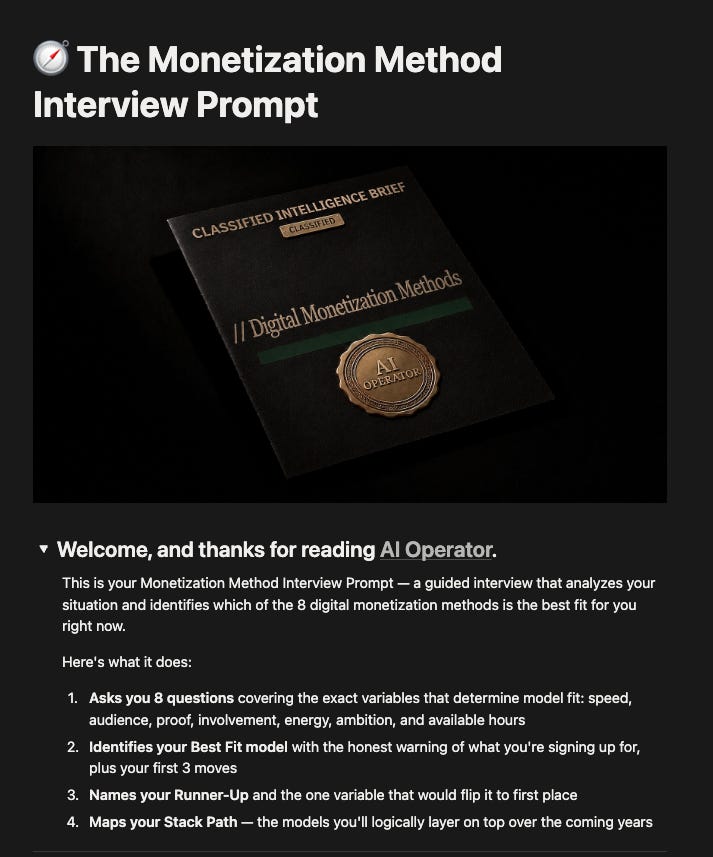
If you made it this far, you might be thinking:
“All of this sounds great. But which method is right for ME?”
Good question - let me help you answer it.
I’ve put together a full 8-question interview prompt that will help you identify which of these methods is best for you, based on your current skills, timeline, audience, experience, energy, and ultimate end goal.
Then, based on your answers, it gives you 3 things:
Your best fit. The one method to start with, why it matches your specific answers, and the 3 hardest problems you’re signing up for so you know what lies ahead
Your second-best fit. The close second, and the one variable in your situation that would flip it to first place
Your “stack path” over time. The 2-3 methods you would logically layer on top over the following years, once your first one is up and running
All you have to do to get it:
Subscribe to AI Operator
Like this post by clicking the heart at the bottom
Leave a comment below or reply to this email with the word METHODS and I’ll send it over to you
And if you have any questions about any of these methods, feel free to leave a comment or hit reply to let me know. I read and reply to every one of them.
Thanks for reading - I hope it was valuable.
Dickie
PS: If you want my direct help implementing one (or multiple) of these monetization methods, come join us inside AI Writing Skool free for 30 days.
If you enjoyed this, read these two articles on optimizing your email list + building your social content cadence
[FULL BREAKDOWN] Revealing Every Email We Send Across 5 Businesses & 250,000 Subscribers
![[FULL BREAKDOWN] Revealing Every Email We Send Across 5 Businesses & 250,000 Subscribers](https://substackcdn.com/image/fetch/$s_!O_kW!,w_1300,h_650,c_fill,f_webp,q_auto:good,fl_progressive:steep,g_auto/https%3A%2F%2Fsubstack-post-media.s3.amazonaws.com%2Fpublic%2Fimages%2Fdb29b00c-3815-4591-81bf-c176b45f5799_1677x938.png)
Welcome back to AI Operator: the weekly newsletter for integrating AI into every vertical of your internet business — one SOP, system, or honest reflection every week that you can steal, install, and run by the end of the week. Last week we added 148 subscribers
[FULL GUIDE] Optimize Your Content Cadence Across All Social Platforms In Under 30 Minutes
![[FULL GUIDE] Optimize Your Content Cadence Across All Social Platforms In Under 30 Minutes](https://substackcdn.com/image/fetch/$s_!0hc3!,w_1300,h_650,c_fill,f_webp,q_auto:good,fl_progressive:steep,g_auto/https%3A%2F%2Fsubstack-post-media.s3.amazonaws.com%2Fpublic%2Fimages%2F4fcc50d0-6b28-4129-a253-ce70000838c1_1677x938.png)
Welcome back to AI Operator: the weekly newsletter for integrating AI into every vertical of your internet business — one SOP, system, or honest reflection every week that you can steal, install, and run by the end of the week. Over the last 3 weeks we’ve